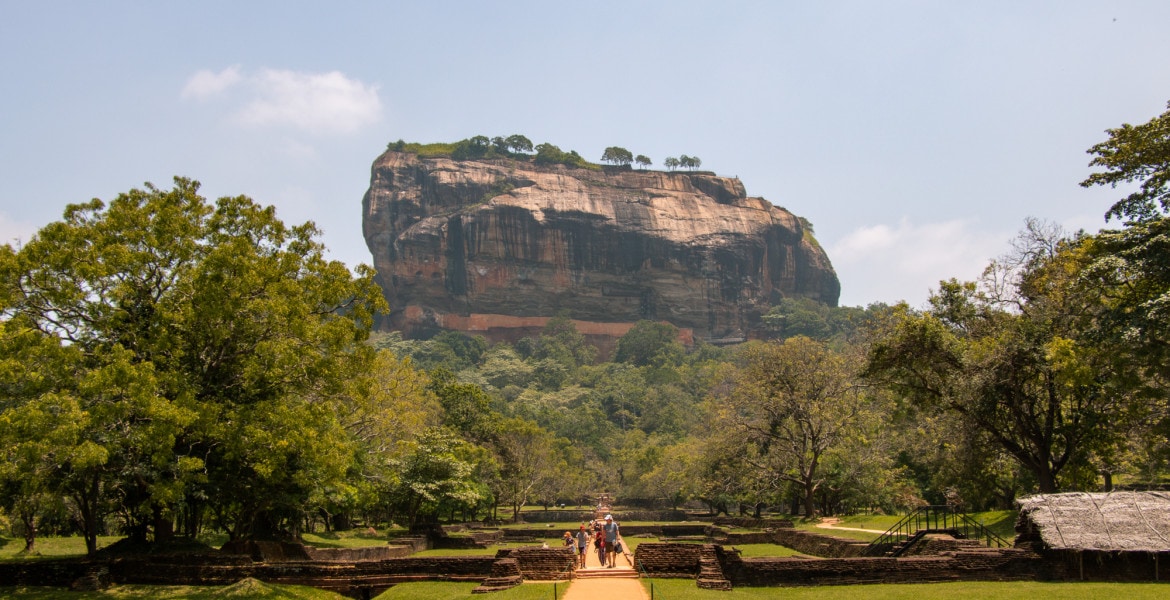
Located in the heart of Sri Lanka, the Lion Rock in Sigiriya is probably one of the most iconic landmarks of the coconut island. Often referred to as the Eighth Wonder of the World by locals, climbing the majestic Sigiriya Lion Rock is a must-activity. Along with its neighboring Pidurangala rock, which gives you a jaw-dropping panoramic view, Sigiriya is a must-add to your Sri Lanka itinerary.
This natural phenomenon is a towering 200m square-shaped rock that rises high from the lush jungle over the surrounding plains. At the top, you can visit an ancient fortress, which is one of the country’s eight Unesco World Heritage sites and is truly a breathtaking sight. Explore the ancient ruins of the former palace and enjoy the views over the in-fog-wrapped forests and lakes below.
This guide covers everything you need to know for climbing the Sigiriya Lion Rock. Travel tips, daypack essentials, how to get to the top, what to see at Sigiriya Rock Fortress and accommodation tips, we got you covered. Because if you haven’t seen the famous Lion Rock, can you even say you have been to Sri Lanka?
* Disclosure: This post contains affiliate links. We will receive a small commission if you book through our links. This is at no extra cost to you. We only recommend products we like and trust ourselves.

Quick Sri Lanka Trip Planning Essentials
VISA
Apply for a tourist visa online, which allows a 30-day stay. Submit your application at least a week before departure to promptly secure your Electronic Travel Authorization (ETA) confirmation.
TRAVEL INSURANCE
Safeguard your backpacking journey through Sri Lanka with comprehensive coverage from Heymondo for trustworthy travel insurance. (Get 5% OFF through our link)
FLIGHTS
Explore the best flight deals to Colombo, Sri Lanka, using Skyscanner.
INTERNET
Airalo eSIM lets you stay connected as soon as you arrive at your destination. Use promo code NEWTOAIRALO15 for 15% off any eSIM (for new Airalo users only). Or use the code AIRALOESIM10 for 10% off as an existing user.
ACCOMMODATION
Charming Homestay ($) Sigiri Rock Side Home stay; Green Oasis ($$) The Cattleya Guest House; Luxury Scenic Heaven ($$$) Water Garden Sigiriya
TRANSPORT
Ready to travel to your next destination in Sri Lanka? Book your onward bus or train tickets via 12go.Asia.
CURRENCY
The local currency is Sri Lankan rupee (LKR), and the exchange rate is around 1 USD = 300 LKR. Check XE Currency Converter for updated exchange rates.
TOURS & ATTRACTIONS
Recommended Sigiriya and Dambulla Day Trip by Tuk-Tuk. For more tours and day trip excursions, check out GetYourGuide or Viator.
All you need to know for climbing Sigiriya Rock
What is Sigiriya known for?
Sigiriya is a small town in the central lands of Sri Lanka and is only a two-hour drive away from Anuradhapura and Kandy. Tourism skyrocketed in recent years in this little town, welcoming thousands of tourists every month. Most specifically for their biggest attraction: Climbing the famous Sigiriya Lion Rock. From miles away you can already spot the magnificent rock formation towering high above the trees.
Sigiriya rock was formed from magma 2 billion years ago, coming from an extinct volcano. In the past, the whole area was filled with volcanic mountains, which is no longer the case. The only two rocks standing are Pidurangala Rock and Lion Rock.
In the middle of the jungle, the Lion Rock was once a palace fortress with lush botanical gardens, colorful frescoes, and water pools. Although only ruins are left on top of the rock, and you can only see the remains of the palace, it still holds major historical significance for Sri Lanka. It’s the most visited site and part of the cultural triangle, that stretches from Anuradhapura to Polonnaruwa and Kandy.
The fortress is the perfect example of advanced ancient engineering and architectural skills, with its marvelous structures. The design of the main entrance to the top of the rock has the shape of a humongous stone lion. This is how the rock earned its name, Lion Rock, because of the image of the entrance. The name Sigiriya comes from the Sinhalese word Sihagri which means Lion Rock. Today unfortunately only the lion’s paws are left at the bottom of the stairs.
Is it worth visiting Sigiriya Rock?
Absolutely, visiting Sigiriya Lion Rock is well worth it. Standing at an impressive 200 meters high, this iconic landmark offers breathtaking views that are absolutely astonishing. When you’re at the top, overlooking the lush surroundings, it’s hard not to be in awe. The sheer scale and ingenuity it took to build an entire fortress on top of a rock are just incredible. Let me tell you, it’s even more impressive in real life!
Whether you’re a history buff, an adrenaline junkie, or simply in it for the views, Sigiriya Rock has something for everyone. Climbing up, you’ll encounter well-preserved frescoes, ancient graffiti, and the iconic Lion’s Paw entrance. And once you reach the summit, the panoramic views and remnants of King Kasyapa’s palace make the effort entirely worthwhile.
However, it’s worth noting that the entrance fee is on the higher side, around $39 for foreign visitors. This might be a drawback for some, especially when compared to other attractions. Many historic sites in Sri Lanka come with a hefty entrance fee due to their UNESCO World Heritage status. So, if you’re traveling on a budget, these costs can add up quickly.
Overall, climbing Sigiriya Lion Rock was a unique experience, one that we can wholeheartedly recommend.
Entrance fee for Sigiriya Lion Rock
The entry ticket to the Sigiriya Rock is not cheap, definitely for those on a tighter backpacking budget. Entrance fees for the Unesco World Heritage sites are the biggest expense in Sri Lanka compared to other things. It is one of the most popular and visited landmarks in the country, for which the entrance fee is 11.772 LKR (~$39) for foreigners (as of 2024). Whereas locals only have to pay Rs.120. Payment is in cash, but there is a smaller building further up with an ATM. You can also pay in dollars, but it will have to be exact as the ticket office can’t give any change in dollars.
Opening hours of Sigiriya Lion Rock
Sigiriya Rock is open every day from 7 AM to 6.30 PM, with the last entry at 5 PM. Once you walk from the parking lot there is a big road going towards the rock. You have to go to the side street on your right to the museum to collect your ticket (see location Sigiriya Museum). Make sure to get your tickets before starting to climb the Rock Fortress or they will send you back. They will check your ticket multiple times on-site, so hold on to your ticket for the whole visit.
Upon arrival at the site, there are plenty of guides coming your way offering their services, in case you’re interested. When buying your tickets you will receive a small booklet with facts about the rock and its history, which we found quite interesting.
JOIN A TUK-TUK TOUR
If you’re short on time and only have one day to explore Sigiriya, we recommend booking this tuk-tuk day trip to maximize your visit. This tour efficiently covers both UNESCO World Heritage sites—the Dambulla Cave Temple and Sigiriya Rock Fortress—without the hassle of organizing transport and logistics yourself. With an English-speaking driver providing personalized attention, you can explore at your own pace. In addition to the ancient cave complex and rock fortress, the tour also takes you through scenic spots and lakes in the countryside. You’ll have the chance to learn more about rural life and witness the daily routines of Sri Lankan villagers.
What is the best time to visit Sigiriya Rock?
Sigiriya is best visited during the dry season, which runs between December and early April. March is overall the best time to go, in terms of weather conditions and visibility. This was also the time we visited Sri Lanka (March 2022). Our day started a little foggy in the morning, but this added to the mystical atmosphere of the jungle.
However keep in mind it’s also the hottest part of the year, which we can fully confirm. It gets really hot and sticky during the day, imagine hiking up a mountain during that weather. Since it’s the best time of the year to visit, it’s at the same time peak tourist season, so expect bigger crowds.
This is why we recommend going as early as possible, the ticket office opens at 7 AM so aim at that. Our tip is to go straight up to the top of the rock, this way you avoid the heat and crowd. After that, you can check out the surrounding gardens and ruins. At peak time you might encounter queues for going up the rock from the middle platform since everybody needs to take the same set of stairs. Otherwise go in the late afternoon for sunset, for cooler weather on your descent. The ticket office closes at 5 PM, so grab your ticket in time.
TIP | You can visit both Pidurangala and Sigiriya Rock on the same day. Since both rocks give you a 360° view of the surrounding green plains, you are not forced to choose one specific rock for sunset and sunrise.
How long does it take to climb up Sigiriya Lion Rock?
You will be pleased to hear that climbing Sigiriya Lion Rock doesn’t take too long. The climb itself takes around 45 minutes to the top, depending on your fitness level & waiting time at the stairs. This doesn’t include the little breaks, time for taking pictures and enjoying the overall scenery. If you are anything like us, count on around 3 hours to spend at the sight. Taking in the gorgeous views, wander around the ruins on the top and the royal gardens at the end of the climb.
How hard is it to climb Sigiriya Rock?
There are around 1250 steps from the bottom all the way to the top. The attraction is pretty accessible for everyone and there are a few platforms in between where you can catch a breath. No matter what your fitness level is though, you will get sweaty. The hike is well-indicated with signs and easy to follow. The most challenging part is probably the last part, where you have to climb a steep metal staircase. I personally am not afraid of heights, but I wasn’t really thrilled about this part either. Do not worry the staircase is well secured and has a steady handrail to hold on to.
If you visit Sigiriya Lion Rock in the morning you will be finished before lunchtime. There are some wonderful restaurants around to bridge the scorching heat of midday. After your break, you can walk the area towards Pidurangala to tackle the other rock for sunset.
Be careful of Monkey Bees-iness
Monkeys hang out very frequently around tourist attractions. Many of them are skilled in grabbing food and drinks so make sure that everything is put neatly away in your bag. We even saw one cheeky monkey stealing a Coca-Cola bottle, fluently opening the top, and enjoying the refreshing drink. No shame whatsoever, but entertaining.
On the grounds, you will also notice warning signs about bees and wasps in the area. Thankfully, we didn’t encounter any, but there are large numbers of nests around the rock walls. Each year there are multiple cases of attacks, so be cautious.
Photography and drone restrictions at Sigiriya Lion Rock
Regarding the bees, there are signs that say they can get aggressive because of drones flying around. This is one of the reasons it’s not allowed to fly drones at the sight. Outside the area, it’s normally allowed to take drone footage from the famous Sigiriya Rock Fortress. But always check the latest updates regarding regulations.
Camera photography is also banned in a few spots along the Sigiriya hike. More specifically on the frescoes wall, you will see clear signs that you can’t miss. This is for the protection and preservation of historic rock paintings. The ban is more strictly enforced nowadays and your camera might get confiscated or you have to delete the taken pictures if you ignore the rules.
Planning a trip to Sri Lanka?
Our 3-week Sri Lanka itinerary has everything you need to plan your trip to the coconut island! This guide covers the top places to visit, travel tips, and must-do activities for each spot. We’ve also added our favorite accommodation and dining recommendations to give your adventure a local flavor.
What to wear to climb Sigiriya Rock?
Unlike the other cultural attractions in Sri Lanka (including Pidurangala Rock!), Sigiriya Rock is not a sacred temple, so you don’t require any cover-up of the knees and shoulders. Still, keep in mind that Sri Lanka is more conservative when it comes to clothing when picking out your outfit ;). Shorts and a top are fine, bring something to protect you from the sun and comfortable shoes.
What to bring for climbing Sigiriya Rock
Here are a few items that we recommend to bring or wear on your Sigiriya visit:
Protection from the sun | Bring a cap, sunscreen (like Sun Bum Original SPF 50), and sunglasses. The sun here is excruciatingly hot and burning, definitely, once you are on top of the rock in the full-on sun. We speak out of the experience. We both had our hairlines burned and the top of our heads, it was not pleasant.
Loads of water and snacks | You will be doing a small workout and with the heat, you gotta stay hydrated. In case you are on the hunt for a Reusable water bottle, we can recommend this Hydro flask. There are small stands at the exit of the rock in case you need some extra refreshments. We can recommend the following lightweight day pack from Deuter to carry your belongings or the WANDRD PRVKE 21L for camera gear.
Comfortable shoes | You will be on your feet all day hiking up and down, so decent sneakers will be your best friend. Some parts can get rather difficult, definitely if decide to tackle Pidurangala later in the day. For this activity, you wanna skip the slippers.
Head torch or flashlight | This is for the early morning or after sunset, it will help you guide your way on the descent of both rocks. At Pidurangala, which we visited for sunset, there are small solar lamps on the pathway, but some extra light will come in handy.
Camera | You don’t want to forget this one, the breathtaking views are just begging to be immortalized on camera!
The background story of Sigiriya Lion Rock
The Ancient Origins of Sigiriya’s Lion Rock
Sigiriya’s history stretches far back into the depths of time, with many stories woven around it. The rock itself, a natural wonder, was formed over two billion years ago. It emerged from the magma of an extinct volcano. In prehistoric times, the natural caves within the rock served as shelters for early tribes. Later, these caves became the refuge of reclusive Buddhist monks. Evidence of human habitation here dates back to the 20th century BC. Some inscriptions discovered on the rock have even led historians to speculate that this site might have been the legendary Alkamandava, also known as the City of Gods.
The Rise of Sigiriya Rock Fortress
The Lion Rock, as we know it today, traces its origins to a royal family feud in the 5th century AD. This ancient fortress was the creation of King Kasyapa, the younger son of the King of Anuradhapura. In a bid to secure his power, King Kasyapa chose this massive 200-meter-high square rock as the site for his new capital.
The story of King Kasyapa is one of betrayal and ambition. He first plotted to seize power by killing his own father. Then, he usurped the throne from his elder brother, Moggallana, forcing him into exile in India. Fearing his brother’s return and retaliation, Kasyapa relocated the capital from Anuradhapura to Sigiriya. This fear was the driving force behind the construction of an invincible fortress atop the rock. He transformed the rock into a grand royal residence, complete with an impressive Lion gateway and surrounded by lush royal gardens. The remnants of these structures can still be seen today. This transformation gave the rock its name, Sigiriya, or Sihagiri in Sinhalese, meaning Lion Rock.
The Fall of Sigiriya and Its Later Years
However, Sigiriya’s time as a capital was short-lived, lasting only 18 years. Moggallana eventually returned with a formidable army to reclaim what was rightfully his. In 495 AD, Kasyapa was defeated in battle and killed, leading to the fall of his fortress. After this defeat, the palace was destroyed. The fortress then served as a Buddhist sanctuary until the 14th century, after which it was abandoned once again. Sigiriya remained lost to history until the 19th century when it was rediscovered by Jonathan Forbes. Despite this rediscovery, actual excavation work did not begin until 1980. Since then, this legendary fortress has attracted millions of tourists from around the world. In 1982, Sigiriya Rock was rightfully declared a UNESCO World Heritage site.
What to see at Sigiriya Lion Rock
These days, climbing the Sigiriya Rock is one of the most popular attractions in Sri Lanka. Your visit starts by entering the main path of the surrounding terrace gardens, which offers you the perfect perspective of the rock ahead. These palace gardens are one of the oldest in the world and the pools supply water to the fortress through ingenious irrigation systems.
From here the climb of the fortress starts. Be prepared for a small challenge and conquer 1200 steps to the top of the mighty Sigiriya Lion Rock. There are clear markings for the carved-out paths to guide you up to the top. The rock is divided into three levels, we suggest heading straight to the middle platform with the lion claws. On your way back down you take the iron bridge on the first level which goes around the rock towards the frescoes and mirror wall.
Below we will take you along all the parts & sights that can be found at Sigiriya Rock Fortress, so you don’t miss anything.
Secure reliable internet access for your Sri Lanka trip with Airalo. Airalo eSIM lets you stay connected as soon as you arrive at your destination. Simply install it on your eSIM-compatible smartphone before your journey. It’s easy, convenient, and affordable + you don’t have to keep switching SIM cards! Use our promo code NEWTOAIRALO15 for 15% off any eSIM (for new Airalo users only). Use AIRALOESIM10 for 10% off as an existing user.
The lion paw gateway
These are the lion paws that contributed to the name of Sigiriya Lion Rock. The gigantic lion’s paws at the foot of the narrow staircase are guarding the entrance to the palace. In the 5th century, the whole stairway was surrounded by a full lion, with the stairs going through the lion’s gaping mouth.
Ascending through the lion’s mouth was a symbolic image for Buddhist devotees. It’s representative of Buddha being Sakya-Sinha or Lion of the Sakya Clan, meaning that his truth was as powerful as a Lion’s roar. Unfortunately, the lion’s head and upper parts were destroyed a long time ago, only the paws remain today.
The summit of the rock
From the middle platform, take the stairs from the lion claws to a steep (and a little bit creepy) metal staircase which will take you to the top of the Rock Fortress. After going up the last part of the narrow metal stairs, we finally make it to the top platform where the palace used to be. The palace complex on the top covers around 1,5 hectares and was at one point in time covered with buildings. Sadly today, only the foundations remain and it’s up to our imagination to visualize the glory of a once luxurious palace. The fortress complex mainly consists of remnants of a ruined palace, canals, alleys, and a garden with ponds. On the east side, you can find the spot where a throne was carved out of a stone slab.
The most mind-blowing aspect of the summit must be the majestic views. The rock gives you an incredible 360-degree view of lush jungles as far as the eye can see. Temples and pagodas scattered over the green plains, with glistering lakes in the distance. You can also see the Pidurangala Rock just a stone’s throw away which we visited on the same day. These stunning views are definitely a reward at the end of conquering all those stairs.
The mirror wall
After taking in the historic beauty at the top, we will start descending. The climb down should be easier, but careful not to slip. For the first part, you will return the same way on the metal staircase towards the middle platform with the lion paws and after that back to the first platform. From here instead of taking the stairs down, take the straight metal bridge along the rock. This will lead you to the mirror wall, which was supposed to be so polished back in the day that the king could look at his own reflection. The wall was made out of bricks with a polishing plaster finish, giving it a mirroring effect. However now it’s so old that it lost its shine, don’t even try to see yourself in it.
The wall had been “vandalized” with graffiti in the past. The writings on the wall date back to the 7th century when visitors to the place would leave a message behind. The writings usually praise the beauty of the place and its paintings. Some even left poetry, so it was not your modern type of vandalism. The inscriptions on the Mirror wall are proof that even back then Sigiriya was a kind of “tourist” destination. Obviously, you can’t leave your name or a tribute behind anymore in order to preserve the historical condition of the wall.
The frescoes
All the way at the end of the mirror wall you will bump into two spiral staircases. Don’t ignore them because going up you will encounter some incredibly well-maintained frescoes of damsels. The murals of the Maidens of Sigiriya still remain in beautiful condition and vibrant in color thanks to the overhanging rock that protected them from natural elements.
According to the graffiti on the Mirror wall, there must have been 500 of those painted all over the rock faces. Many archeologists also attempted to interpret the identity of the beautifully portrayed women in these ancient masterpieces. Some say they were King Kasyapa’s concubines heading towards the Pidurangala temple for worshipping and offering fruit trays and flower petals. Others said the damsels represent Apsaras or goddesses. Another interpretation by a Sri Lankan archeologist is that the damsels are a symbolic representation of rainclouds and lightning. The dark-skinned maidens are a symbol of the rainclouds, whereas the fair golden-skinned ones symbolize lightning. Unfortunately today, not many frescoes are left and it’s forbidden to take pictures of them. This is in order to preserve the damsels since flash photography can damage the colors. (The picture above is stock footage.)
The royal gardens
Once you are done on higher grounds, there is still a lot to see while descending and on the bottom level. On your way, you will encounter many ruins and caves, of which the most famous one is the Cobra cave. Surrounding Lion Rock you have beautiful royal gardens which consist of water gardens, boulder gardens, and terraced gardens. They are believed to be one of the oldest landscaped gardens in the world. Complex hydraulic systems run through the gardens in the form of underground water pumps, canals, and dams. It’s truly a lovely place to stroll through and maybe enjoy some snacks at the end of your climb.
Where to eat in Sigiriya?
We had a few hours to kill after climbing Sigiriya Lion Rock and before heading out for the Pidurangala Rock. Besides we worked up quite an appetite, so we went on the hunt for a nice lunch place. We left the site via the south entrance and after just a five-minute walk we found our way to Tharumila restaurant. The main reason we chose the place was because of its location, it has the perfect view of Lion Rock while you enjoy your food. The hostess was really friendly and we enjoyed an amazing Sri Lankan curry. Make sure to order one of their fruit juices which are divine, we can only recommend our personal favorite, the maracuja juice. The whole lunch with drinks came down to 1500 LKR (~$5), great value, and a relaxing place to enjoy a delicious meal!
Another favorite amongst tourists in Sigiriya is Pradeep restaurant. Many seem to like the place’s roti which is supposed to be one of the best. Roti is one of the traditional Sri Lankan dishes and one you must try while there. For a little bit of a party or just a great atmosphere to end the day, head over to Rasta Rant. They are known for their barbecue dishes and cocktails, but even more for their good vibes with their outdoor setting and music.
Where to stay in Sigiriya?
Which is better to stay: Dambulla or Sigiriya?
The town of Sigiriya itself is focused around the main road with multiple side alleys leading towards the jungle. The area has a relaxed vibe with cozy restaurants right in the greenery. Most of the guesthouses are scattered all over the area around the two rocks.
Staying in Sigiriya is perfect if you are looking for a more idyllic location right within nature. There are plenty of accommodations to find, for everyone’s budget. Just for convenience make sure to pick one that is not too far from the rock, since most restaurants are around there.
As mentioned in our Dambulla post, it makes the most sense to base yourself in one place to explore all the sights in this region of Sri Lanka. You can easily get around from here to Polonnaruwa, Dambulla for the cave temple, as well as different safari trips. Choosing between a stay in Dambulla (which is about a 30-minute drive away) or Sigiriya depends on personal preference. Dambulla is more hectic since it’s a trade hub and a more ‘strategic’ spot to stay since the main bus station is here. So in case, if you have a hectic itinerary that would be a good option for you. Also, note that Dambulla is less tourist-minded, so there aren’t really bars & restaurants around. So, if you want a more laidback and relaxing environment with cozy restaurants we definitely recommend Sigiriya over Dambulla.
Below are some great options if you are looking for a nice place to stay in Sigiriya that suits all different budgets:
MID-RANGE | The Cattleya Guest House
If you are looking for a nice guest house to sleep in, then The Cattleya Guest House might be the perfect fit for you. It’s a beautiful stay, with new and clean rooms with a cozy terrace towards the garden.
BUDGET | Sigiri Rock Side Homestay
Another guesthouse stay option is the Sigiri Rock Side Homestay, you will love the scenery of this one. Right in the lush green surroundings from the rocks. You can enjoy a relaxing evening on the porch of this little slice of heaven at the end of the day.
LUXURY | Water Garden Sigiriya
If you want to treat yourself to a beautiful hotel with a pool with a view of Lion Rock, there is the Water Garden Sigiriya. Surrounded by rice fields, this relaxing resort offers you your own luxurious villa. They offer top-quality service with a spa, pool, restaurant, and bar at your disposal.
How many days to spend in Sigiriya?
If you are on a tight schedule for your trip, then one night is enough to see the highlights around Sigiriya. Upon your arrival in the afternoon, you could directly head out to Pidurangala Rock for the perfect sunset view of the Lion Rock. In the morning you can climb Sigiriya Rock itself. If you would like to see the Dambulla Cave Temple, it’s perfectly possible to pass by Dambulla just before jumping on a bus to Kandy or Anuradhapura. The ticket office has luggage storage, so you can drop off your bags while you go exploring.
However, we would recommend 3 nights in total for Sigiriya / Dambulla to catch all the sights this region in Sri Lanka has to offer. Climbing Sigiriya Rock and Pidurangala Rock, take a day trip to the historic city of Polonnaruwa, see the magnificent Cave Temples in Dambulla, and maybe squeeze in a safari trip to Minneriya & Kaudulla National Park.
How To Get To Sigiriya, Sri Lanka?
Sigiriya is located in the Matale District in the central province of Sri Lanka. The city is part of the cultural triangle formed by Anuradhapura, Kandy, and Polonnaruwa.
How to get to Sigiriya from Dambulla
Dambulla is the nearest city, where you initially arrive from other cities at the main (intercity) bus station. Here you can catch the local bus or a tuk-tuk to get to Sigiriya.
Tuktuk is the easiest and fastest option to get to Sigiriya, it’s only a 30-minute drive away. Ask the driver to take the road along Lake Kandalama. The drive is just a little longer but gives you amazing views of the landscapes of Sigiriya. Price-wise a tuk-tuk should cost you between 1000 and 1500 LKR (~$4-6), depending on your negotiation skills ;).
The local bus is another option, they are cheap and run regularly. You catch the bus at Dambulla Main Bus station, this is also where intercity buses arrive from other cities. Buses go every 30 minutes and take around an hour to get to Sigiriya. The first bus in the morning leaves at 6.45 AM until 6 PM and tickets will cost you only 50 LKR one way (20 cents). From the bus stop in Sigiriya, it’s a 10-minute walk to the ticket counter of the Rock Fortress.
How to get to Sigiriya from Anuradhapura
Besides hiring a private car, the only and best way to get to Sigiriya from Anuradhapura is by taking the bus. There are two bus lines running between Anuradhapura and Kandy, bus number 42 or 43 (line Kandy – Vavuniya), and they make a stop in Dambulla. Bus line 43 is the more ‘luxurious’ bus van with AC. These usually go every 30 minutes and the trip takes 1,5 hours. It will cost you around 400 LKR per person (less than $1,5), so it’s very affordable. Once you arrive in Dambulla you will need to catch the local bus or a tuk-tuk to go to Sigiriya (see above).
How to get to Sigiriya from Kandy
The easiest and most budget-friendly way is to take the bus from Kandy to Dambulla and swap there to the local bus or tuk-tuk using the directions mentioned above. Go to Kandy central bus station (which is opposite the train station) and take bus 42 or 43 (the one with AC) in the direction of Dambulla. The journey should take a little over 2 hours and the air-conditioned bus will cost you 450 rupees (roughly $1,5). Buses usually depart every 30 minutes.
JOIN A GUIDED TOUR
If you’re short on time and can only manage a day trip from Kandy, we recommend booking this private guided tour to make the most of your visit to Dambulla and Sigiriya. This full-day tour covers both UNESCO World Heritage sites—the Dambulla Cave Temple and the Sigiriya Rock Fortress—without the hassle of organizing transport & logistics yourself. You’ll receive personalized attention from your English-speaking guide, allowing you to explore at your own pace. Learn about the ancient cave complex and the rock fortress through guided commentary tailored to your group’s interests.
How to get to Sigiriya from Colombo
If you are traveling from Colombo and you wish to take the train, head over to Colombo Fort Station. From there take the train to Habarana station, this is a town 15km up north from Sigiriya. Train tickets for the second class will cost you around 450 LKR (~1,5) and take around 5 hours. You can check the train schedule via the Sri Lankan Railway Website. Train tickets upfront can be booked through 12GO.Asia. However, buying your tickets directly at the station will be cheaper. In Habarana you have to transfer to the local bus or a tuk-tuk to Sigiriya. There are also frequent AC express buses running between Colombo and Dambulla. Take the bus in the direction of Polonnaruwa.
Practical Travel Resources
TRANSPORTATION | For hassle-free bus, minivan, and train bookings across Sri Lanka, we recommend using the user-friendly platform 12go.Asia. Skip the queues and reserve your tickets in advance, especially during peak seasons.
ACCOMMODATION | Booking affordable accommodations in Sri Lanka is effortless with Booking.com. This platform is perfect for discovering budget-friendly hostels, guesthouses, and hotels tailored to your preferences.
FLIGHTS | Find the best flight deals to Sri Lanka on Skyscanner. Benefit from their feature highlighting the cheapest days to fly and the flexibility to search by month or region.
TRAVEL INSURANCE | Ensure comprehensive and reliable coverage for your backpacking journey in Sri Lanka with Heymondo. Prioritize peace of mind with their trustworthy travel insurance options. Get 5% OFF through our link.
STAY CONNECTED | Guarantee reliable internet access throughout your Sri Lanka trip by using Airalo. Install it on your eSIM-compatible smartphone before your journey for convenient connectivity. Use promo code NEWTOAIRALO15 for 15% off any eSIM (for new Airalo users only). Or use the code AIRALOESIM10 for 10% off as an existing user.
TOURS & ATTRACTIONS | Explore the best city tours, day excursions, safari trips, and cooking classes in Sri Lanka with GetYourGuide or Viator.
VISA ORGANIZATION | Check visa requirements for your passport nationality before your Sri Lanka trip with iVisa.com.
ONLINE PRIVACY | Always safeguard your online activity and digital privacy when using public Wi-Fi abroad by using a VPN. We’ve trusted ExpressVPN for years! Plus, a VPN lets you stream Netflix shows from any country. Get 3 months FREE when getting a 12-month plan with our link.
Pin it to Pinterest for later!


