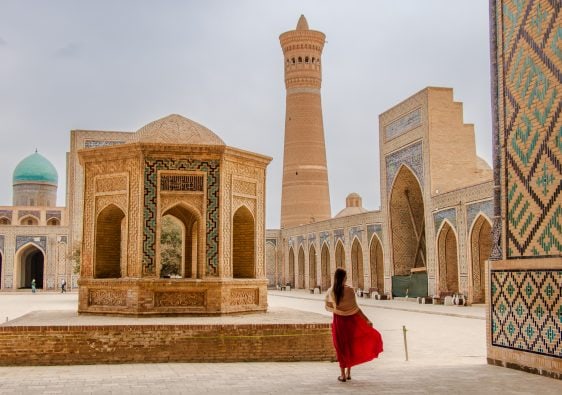
Nestled in Uzbekistan’s Khorezm Region, Khiva is a stunning desert town and one of the most well-preserved Silk Road cities. Essentially an open-air museum, Khiva boasts over 50 historical sites, offering plenty of things to do. The old city of Khiva truly reflects how we imagined ancient cities from Thousand and One Nights tales to look like. With its fortress walls, clay-colored houses, and glittering turquoise minarets, Khiva almost resembles a sandcastle town. This Silk Road town enchanted us with its carpet-weaving shops, beautiful minarets, and historic madrasahs. This complete guide to Khiva in Uzbekistan provides everything you need for your visit, from the best things to do and see in Khiva, to where to stay, and practical tips on getting around and more.
* Disclosure: This post contains affiliate links. We will receive a small commission if you book through our links. This is at no extra cost to you. This way you’re helping us write awesome travel guides and keep providing you with free content. We only recommend products we like and trust ourselves.

Quick Uzbekistan Trip Planning Essentials
VISA
Uzbekistan introduced FREE VISAS ON ARRIVAL or e-visa for most nationalities (30 days). Check the visa requirements on ivisa.com for your nationality before you go.
TRAVEL INSURANCE
Heymondo is our top recommendation for comprehensive and trustworthy coverage for Uzbekistan. Get 5% OFF through our link.
FLIGHTS
Discover the best flight deals to Uzbekistan on Skyscanner, and check for flights to Tashkent (the capital).
INTERNET
Airalo eSIM lets you stay connected as soon as you arrive at your destination. Use promo code NEWTOAIRALO15 for 15% off any eSIM (for new Airalo users only).
ACCOMMODATION
Cozy Guesthouse ($$) Guesthouse Khiva Boyjon Ota ; Boutique Hotel ($) Nazira Boutique Hotel & Terrace ; Unique Stay ($$) Feruzkhan Hotel
TRANSPORT
The easiest way to travel around Uzbekistan is by railway. During high season it’s advisable to book your train tickets online upfront.
CURRENCY
The official currency is Uzbekistani Som (UZS). Check the Xe.com app for current exchange rates. Current exchange rate: $1 = 12,500 UZS and €1 = 13,000 UZS.
TOURS & ATTRACTIONS
This Khiva Highlights Tour takes you to all the famous landmarks. For more tours and day trip excursions, check out GetYourGuide or Viator.
LANGUAGE
Basic English is spoken in major cities, but knowing basic Russian comes in handy! Recently we have been loving the Ling App to pick up some language basics.
ONLINE PRIVACY
Safeguard your online activity and digital privacy when using public Wi-Fi abroad by using ExpressVPN. Get 3 months FREE when getting a 12-month plan with our link.
Things to Know Before Visiting Khiva
Is Khiva Safe for Tourists?
Khiva is very safe, with the whole inner city designed for tourists. The country has a very low crime rate, making it feel safer than many European cities. We often took evening walks, even in the side streets, and always felt secure. Like Samarkand and Bukhara, Khiva benefits from a strong tourist police presence, making petty crimes like mugging and pickpocketing rare. If you ever encounter a problem, there is a Tourist Police booth near the entrance of the West Gate.
As always, be mindful of your surroundings and keep your valuables secure, just as you would anywhere else. It’s wise to have travel insurance that covers both health and theft. This ensures you’re prepared for any unexpected situations during your trip.
The Best Time to Visit Khiva
Khiva is located in the Khorezm region of Uzbekistan and has a desert climate, meaning it remains dry for most of the year. The best months to visit are during spring (April to mid-June) and autumn (September to mid-October). However, these periods are high season, so expect to see many tourists. Notably, Uzbekistan attracts organized group tours that visit must-see sights simultaneously. Despite this, you can still find moments when the old city feels quieter.
If you want to avoid tourist groups you could consider traveling to Uzbekistan during summer or winter if you don’t mind facing extreme temperatures. In summer, temperatures can soar to 40°C (104°F), making it extremely hot. Winter, on the other hand, brings arctic winds from Siberia, with freezing temperatures dropping to -7°C (19°F). So when is the best time to visit Khiva? For the best weather and to avoid crowds, aim to visit in April or from mid-October. This allows you to enjoy Khiva’s charm without the swarms of tourists. We visited Khiva during the second week of October, just as the high season was winding down. This timing meant fewer organized group tours, and we rarely saw other foreign tourists. Evenings were getting chillier, so we recommend bringing a sweater and long pants.
How Many Days to Spend in Khiva
Although Khiva is located a bit further from the main tourist path in Uzbekistan, it’s absolutely worth the journey. Unlike Samarkand and Bukhara, Khiva’s attractions aren’t as spread out and are compactly located within the inner city, Itchan Kala. While you could tour the old town in a single day, we believe Khiva deserves two full days to truly appreciate its wonders. The city’s narrow side streets, beautiful handicraft shops, and cozy restaurants make it a delightful place to explore. We spent three full days in Khiva and never felt bored. This charming town stole our hearts and became our favorite spot in Uzbekistan.
For a deeper understanding of Khiva’s history and significance, consider joining a guided walking tour. These tours typically last about five hours, giving you ample time to explore the city at your own pace afterward.
How to Get Around Khiva?
The old town area of Khiva, known as “Ichan Kala,” is compact and easily walkable. You can effortlessly navigate between the main attractions on foot. Getting lost in the narrow streets of this open-air museum is one of the best things to do in Khiva. For a more strategic approach to exploring, there are options to obtain a map of Khiva. Head to the visitor center for a paper map, where you’ll find plenty of information about Khiva. Near the West Gate, there’s a big map on display that you can snap a picture of.
The only time you’ll need a taxi is to go from the city center to the train station (a 10-minute drive) or to Urgench airport (a 30-minute drive). The typical taxi rate is around 12,500 som ($1.25 USD) for a 10-15 minute ride. Since June 2024, the Yandex App is also functioning in Khiva and Urgench, which wasn’t the case during our visit.
Many visitors choose to hire a guide for a day because some places inside Itchan Kala are hidden and hard to find. A 5-hour walking tour with an English-speaking guide will teach you more about the old town’s history, interesting facts, and hidden gems.
Access to Khiva’s Itchan Kala
Most of Khiva’s attractions are located within the historical Itchan Kala, enclosed by high fortress walls. You can enter Itchan Kala without a ticket. However, accessing certain sights requires the Itchan Kala ticket, which can be purchased at the west gate for 150,000 som (~$10) and is valid for two days. Upon buying your ticket, you’ll receive a map showing all the main historical sites inside Itchan Kala.
The ticket includes access to most attractions, but some, like the city walls, climbing the Islam Kodja minaret, and the Pahlavan Mahmoud Mausoleum, come at an extra cost payable at the site. Check which attractions you want to visit and decide if the ticket is worth it. In our opinion, the Kuhna Arc and the Tash Hovli Palace alone make the museum ticket worthwhile.
Itchan Kala is open 24 hours, so you can enjoy evening walks even if your accommodation is outside the city walls. Attraction opening hours vary by season: 8 am – 8 pm in high season and 9 am – 6 pm in low season.
UPDATE | As of 2023, there is only one type of Itchan Kala ticket, replacing the previous VIP, Standard, and Economy options. This ticket includes access to certain sights as described above.
Packing Essentials for Khiva
- Lightweight Cotton Scarves: Essential for covering up in mosques or religious sites. Keep one handy in your bag to be prepared.
- Loose Dresses and Long Skirts: Opt for breathable, flowy outfits to stay cool in the heat while dressing modestly.
- Reliable Daypack: A good daypack is crucial for daily outings. Look for a lightweight option from brands like Deuter or WANDRD if you’re bringing camera gear.
- Comfortable Walking Shoes: Go for lightweight everyday shoes or sandals like Birkenstocks. You will be doing a lot of walking inside the Itchan Khala of Khiva, so you’ll want comfortable footwear for exploring. ( his / hers )
- Reusable Water Bottle: Staying hydrated is key. For safer drinking water, consider a GRAYL bottle.
- Action Camera: Capture all your adventures! We’ve found the GoPro Hero 10 to be a reliable choice for videos on the go.
- Camera for Photography Enthusiasts: Khiva is so photogenic, that you won’t be able to put down your camera! An entry-level DSLR like the Canon EOS Rebel T7/2000D or a mirrorless camera like the Sony Alpha A6100 or Sony α6400 is worth considering.
- Universal Adapter: Since Uzbekistan has different plug types, a universal adapter is a must to keep your devices charged.
- Power Bank: A power bank is a lifesaver for long travel days when power outlets may not be available, especially during train rides or extensive sightseeing.
Where to Stay in Khiva?
Looking for a hotel in Khiva can feel overwhelming due to the surprising number of boutique-style guesthouses and hotels. For such a small city, there are many great options. We recommend staying within the walls of Itchan Kala (Old Town Khiva). We handpicked three options, two of which we personally stayed in. All are locally run, traditionally decorated, and within walking distance of the main attractions.
Stay inside a former Madrasah – Feruzkhan Hotel
For a unique experience, stay inside a majestic ancient madrasah in the historic inner town at Feruzkhan Hotel. The beautifully refurbished rooms are decorated in typical Uzbek style. We loved our stay here, finding the rooms very comfortable. Breakfast in the serene inner courtyard was amazing!
Rooftop balcony with a view – Nazira Boutique Hotel & Terrace
We spent one night at Nazira Boutique Hotel & Terrace, which offered a different but equally enjoyable experience. The rooms are comfortable, and adorned with colorful Uzbek textiles. The best part is its location near the main square and its cozy rooftop balcony with a view!
Cozy guesthouse with garden – Guest House Khiva Boyjon Ota
Guesthouse Khiva Boyjon Ota, our backup option, also caught our eye. This cozy guesthouse features a beautiful garden filled with flowers and fruit trees, along with a traditional tapchan for guests to rest. The comfortable, spacious rooms and the helpful, kind owners receive rave reviews.
A Brief History of Khiva
Stepping Back in Time
When you enter Itchan Kala, the inner city, it feels like stepping back to the 16th century. This period marked the flourishing of the Khanate of Khiva as a significant trading post along the Silk Route. Within the walls of Itchan Kala, spices, camels, and luxurious carpets changed hands. Khiva was the center of the northern branch of the Great Silk Road, serving as the last resting place for caravans before they crossed the desert to Persia. Built according to ancient Central Asian town traditions, Itchan Kala has a rectangular layout and over 50 historical sites, making it feel like an open-air museum. However, Khiva’s history stretches back over two millennia.
Legends and Historical Significance
Legend has it that Shem, son of the Biblical patriarch Noah, discovered a well while crossing the desert. Locals flocked to it and exclaimed “khey-vakh!” meaning “sweet water.” This is how Khiva was born. Today, the original well can still be seen inside an 18th-century courtyard in Khiva’s Old Town. Throughout its history, Khiva was part of various states and became a center of culture and education. However, in 1220, Genghis Khan destroyed the city, leaving it in ruins for a long time. In the early 16th century, Khiva became the capital of the Khiva Khanate, founded by a branch of the Shaybanids. However, during those times Khiva’s history also developed a dark side, as it was known for being the largest slave center in Central Asia. The ruling Khan treated slaves poorly, reportedly nailing their ears to walls to prevent escape.
Modern Developments and UNESCO Recognition
In 1740, Nadir Shah of Persia invaded and made Khiva part of the Persian Empire. In 1924, the Soviets took over the region until the collapse of the USSR in 1991. Most of what you see in Khiva today was built in the 18th and 19th centuries and restored by the Soviets in the seventies. Today, Khiva is a UNESCO World Heritage Site with more than 50 historical sites.
Best Things to Do in Khiva
Khiva is often the final stop on the usual Uzbekistan itinerary. While it does attract tourists, it feels less busy compared to Bukhara and Samarkand. Here, you can easily step off the main walking street and immerse yourself in the charm of the old city, also known as Itchan Kala.
Back in the 19th century, Khiva was divided into two parts: Itchan Kala (inner city) and Dishan Kala (outer city). The inner city was enclosed by 10-meter (32 ft) tall fortress walls, which were repeatedly destroyed and rebuilt throughout history. This area was home to the khans (rulers), along with clergies, high officials, and wealthy merchants. Meanwhile, craftsmen and ordinary people lived in Dishan Kala.
Today, the inner city functions as an open-air museum. With over 50 historical monuments, it offers a fascinating glimpse into a typical medieval Oriental town. The Ichan Kala is accessible 24/7, allowing you to explore as early or as late as you wish. Stargazing in a quiet spot late at night is highly recommended! However, the historical attractions, such as museums, mosques, and minarets, are only open between 8:00 AM and 6:00 PM.
1. Marvel at the unfinished Kalta Minor minaret
The iconic Kalta Minor Minaret is one of the most popular sights in Khiva, easily visible from anywhere within Itchan Kala. Its peculiar shape makes it quite famous. Built around 1850 under the rule of Mohammed Amin Khan during the Khiva Khanate, the beautiful turquoise-tiled minaret was intended to be 80 meters tall. The Khan wanted it to overshadow the one in Bukhara and showcase his khanate’s power. Unfortunately, he was killed in battle before construction was completed, leaving Kalta Minor unfinished at 29 meters (95 ft) tall. The name ‘Kalta Minor’ actually means ‘short minaret’. The gorgeous decorations on the minaret were crafted by Khiva’s best artisans, making it a truly one-of-a-kind architectural beauty.
2. Get lost inside the impressive Kuhna Ark Fortress
Ever wondered how a Khan used to live? Head over to Kuhna Ark fortress, the former residence of Khiva’s ruler. It housed not only the khan but also his close and extended family, his harem, and even a private mosque. As you wander around, you’ll come across a throne room and a large reception hall adorned with stunning tilework. The compound also included a barrack and a jail.
Measuring a vast 1.2 hectares, the fortress is the largest building in Itchan Kala. It’s a labyrinth of courtyards, narrow corridors, and intriguing rooms, all designed to provide the utmost privacy for its inhabitants. Spend at least an hour exploring before heading up to the watchtower (more on that below).
Located by the west gate of the city, right on the main square in the heart of Itchan Kala, the original structure of the fortress was erected in the 12th century. However, like much of Itchan Kala, it underwent numerous reconstructions, most notably a significant renovation in the 17th century.
Entrance Fee | Included in the ticket, an additional fee of $2 to climb the watchtower
Opening Hours | 9 am – 6 pm daily
3. Catch the sunset from the Kuhna Ark watchtower
We suggest visiting the Kuhna Ark in the late afternoon. This timing allows you to stay and watch the sunset from the main watchtower of the fortress. These watchtowers once protected the fortress and the city against potential invaders. Today, experiencing a sunset from this vantage point is one of the most beautiful things to do in Khiva. The watchtower offers a panoramic view of the entire old city center, letting you admire the city’s sandstone-colored structures from above. You can access the towers via stairs located at the back of the throne room. Usually, guards are at the entrance of the stairs, and you need to pay an additional $2 fee. However, when we visited, no guards were present, so we got lucky.
4. Spend the night insight a former Madrassah
Throughout Uzbekistan, you can visit former madrasahs or Islamic schools, often filled with vendors selling handcrafted souvenirs. However, in Khiva, several madrasahs have been turned into hotels. Staying inside a madrasah was high on our wishlist, and we found the perfect place in Khiva. In the heart of Itchan Kala, the Feruzkhan Hotel has transformed former classrooms and student rooms into beautiful guest rooms. The courtyard offers a perfect oasis to return to during the day. We absolutely loved our stay here and can recommend it to everyone!
Another popular converted hotel is the Orient Star Khiva Hotel, located right next to the Kalta Minor Minaret. This two-story building, formerly known as the Mohammed Amin Madrasah, used to be one of the largest madrasahs in Central Asia.
5. Get a panoramic view from the Islam Khodja minaret
Aside from the eye-catching Kalta Minor Minaret, another building dominates the skyline of the old town of Khiva: the Islam Khoja Madrasah. Standing 56 meters (184 feet) tall, it is the highest building in Itchan Kala and was the first site in Uzbekistan to be included in the UNESCO World Heritage List. Although the minaret was only built in 1910 during the Khiva Khanate, making it relatively new compared to the 1500-year-old Itchan Kala, it was once used to call for prayers.
Today, you can climb this minaret for a spectacular bird’s-eye view of Khiva. Keep in mind that the staircase is very steep and narrow, so your clothes and backpack might get dusty. Next to the minaret, you’ll find the Khodja Madrasah, which houses a museum about the history of Khiva. The museum displays a large collection of Khorezm handicrafts, including woodcarvings, tilework, and Uzbek carpets.
Entrance Fee | Climbing the Minaret is not included in the Itchan Khala ticket. Pay 100.000 UZS ($15) at the entrance to go up.
Opening Hours | 8 am – 6 pm daily
6. Go shopping for handicrafts near the East Gate
The streets of the Old Town are lined with vendor stalls stretching from the West Gate to the East Gate. Souvenir shops are scattered everywhere, occupying both the streets and rooms in old madrasas. This abundance of vendors brings a lively and colorful atmosphere to the area. If you haven’t picked up souvenirs in Samarkand or Bukhara, you’ll find plenty of beautiful items here as well.
What we loved is that each city offers its own unique variety of handmade goods. In Khiva, we discovered many musical instruments, glazed pottery, woodwork, and silk rugs that were new to us. As Khiva is a desert city, you’ll also find fur hats, scarves, and socks made from camel hair.
Additionally, there are a few indoor bazaars, such as the Allakulli Khan Caravanserai, where you can buy everything from jewelry and scarves to suzanis (traditional hand-embroidered textiles).
7. Visit the carved columns of Juma mosque
Woodworking has long been a tradition in Khiva, and this is beautifully showcased at the unique Juma Mosque. Known as the “Friday Mosque,” it is the oldest mosque in Khiva.
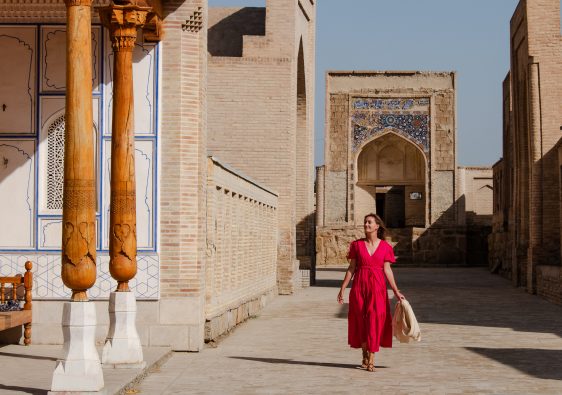
Unlike typical mosques in Uzbekistan, which feature arched entrances and domes, the Juma Mosque is distinguished by its 218 wooden pillars supporting the roof. Light filters in through a central skylight, casting a soft glow on the intricately carved details of each pillar—no two are the same. Some pillars are plain with minimal carvings, while others feature elaborate designs, showcasing various woodcarving styles from Khiva’s history.
Many of these wooden pillars are made from almond and elm trees from the region and date back to the 10th, 11th, and 14th centuries. You might notice some pillars covered in plastic; these are either newly replaced or under repair to preserve the mosque’s heritage.
Entrance Fee | Included in the ticket
Opening Hours | 9 am – 6 pm daily
8. Wander around the stunning Toshhovli Palace
The Toshhovli Palace, also known as the Stone Palace or Tash Khauli, is a must-visit during your trip to Khiva. This grand palace was the summer residence of Allah Kuli Khan and features some of Khiva’s most extravagant interior decorations. With over 150 rooms and 9 courtyards, it’s a remarkable example of opulent architecture.
The palace is divided into three main sections: The Harem, The Entertainment Halls, and The Court of Justice. As of 2023, you cannot move between these sections; each has its own entrance. The first entrance showcases a horse carriage given to Khan Mukhammad Rakhimkhan II in 1876. Inside, you’ll find two nearly identical rooms adorned with beautiful blue tiles, and one room features a yurt in the courtyard. We basically had this place to ourselves, as we think not many people know about this section.
The second entrance, marked by a sign for the “Museum of Handicrafts,” leads to the Harem. This area housed the Khan’s 5 official wives and, reportedly, 41 concubines. The wives lived in the intricately decorated rooms on one side of the courtyard, while the concubines occupied simpler rooms on the other side. Highlights include the Khan’s richly decorated room and the stunningly carved and colorful ceilings in the huge courtyard.
Entrance Fee | Included in the ticket
Opening Hours | 9 am – 6 pm daily
9. Walk along the city walls of the Itchan Kala
Unlike Samarkand and Bukhara, the old city of Khiva is completely surrounded by city walls. These walls have been partially reconstructed, allowing visitors to walk along the northern and northwestern sections. The imposing 10-meter (33 feet) brick walls once protected Itchan Kala, with guards on the lookout for anyone who threatened the Khan or the traders passing through to and from Iran. Today, walking along these walls is a great spot for Khiva sightseeing, offering beautiful aerial views of the old city center. It’s definitely one of the best things to do in Khiva.
Keep in mind that the walk is not a loop, so you will need to retrace your steps and hop on and off at the same spot. The stairs leading up to the Itchan Kala city walls are near the North Gate. We decided to go up in the late afternoon to enjoy a stroll before sunset; the light was absolutely beautiful, casting warm tones on the sandstone buildings. Although we read online that this was a free activity, that’s no longer the case in 2024, as booths have been installed near the northern watchtower. Certain entry points are now closed off, so it’s not possible to roam around freely anymore.
Entrance Fee | 20.000 Som
10. Watch the sunset from a rooftop restaurant
We are always up for a delicious dinner with a view. Enjoying a traditional Uzbek meal from a rooftop terrace during sunset, with vistas of the Kalta Minor, is one of our favorite memories of Khiva. If you have been following us for a while, you know we avoid tourist traps and rarely visit internet-famous bars and restaurants. However, Terrassa Cafe & Restaurant is an exception. It is popular, for good reason! Certain terrace tables are highly coveted, so we recommend walking by to make reservations.
Despite its popularity, the service is impeccable. The staff is really sweet and helpful, and the food is delicious. We had one of the best dining experiences of our trip to Uzbekistan here. Besides the typical dishes, they offer the local Khiva specialty Shivit Oshi and a delicious meat pie. The Terrassa Cafe in Khiva is the perfect place to end your day of exploring, watching the sun dip behind the Kuhna Ark. We enjoyed it so much that we returned the next day for afternoon tea and pie, as they have a huge selection.
Get Connected with an eSIM
Secure reliable internet access for your Uzbekistan trip with Airalo. Airalo eSIM lets you stay connected as soon as you arrive at your destination. Simply install it on your eSIM-compatible smartphone before your journey. It’s easy, convenient, and affordable + you don’t have to keep switching SIM cards! Use our promo code NEWTOAIRALO15 for 15% off any eSIM (for new Airalo users only). Use AIRALOESIM10 for 10% off as an existing user.
11. Admire the rich tilework of Pahlavan Mahmoud Mausoleum
One of the must-visit places in Khiva is the Pahlavon Mahmud Mausoleum, which houses the tomb of the city’s patron saint, Pahlavon Mahmud. You can easily spot its vibrant blue dome from any old city viewpoint. Pahlavon Mahmud was one of Khiva’s greatest heroes—he was a famous poet, philosopher, and rescuer of many. Over time, his burial place eventually became a shrine and also the resting place for Khiva’s khans.
Furthermore, the mausoleum is a popular pilgrimage spot where people pray and drink holy water. Inside, you’ll see incredible examples of Persian architecture and tilework. The chambers are beautifully decorated with blue-patterned glass mosaics. Additionally, the grand chandelier in the main hall illuminates the intricate decorations that extend up to the ceiling. Remember to keep your voice down and dress modestly, as this is still a mausoleum.
Entrance Fee | Not included in the Itchan Kala ticket, 25.000 SUM
Opening Hours | Daily from 9 am until 6 pm
12. Catch the Khiva Folk Dance performance at the Kuhna Ark
During our time in Khiva at the beginning of October, there was a folk dance performance every evening near the West Gate, in front of the Kuhna Ark. We could hear the music and drums all over the Itchan Kala. In the evening we had dinner at Terrassa Cafe & Restaurant for sunset, and we also happened to catch the show. Talk about front-row seats!
The performance lasted at least 30 minutes and featured a popular style of dance known as “Lazgi” Khorezm dance, renowned for its fiery nature. This dance was included in the Representative List of the Intangible Cultural Heritage of UNESCO in 2019. These dances often reflect the soul of everyday people, with national music and clothing. Each performer was dressed in beautiful, bright Uzbek traditional clothing.
We heard that these dance performances are an initiative by the city of Khiva. We’re not sure if these performances happen throughout the entire tourist season or only at certain times of the year, but we hope you get to catch a performance during your visit!
13. Stop by local Handicraft workshops
Wandering around Itchan Kala, you’re likely to come across locals making handicrafts inside workshops hidden in small alleys and madrasahs. Handicrafts, particularly woodwork, have been a longstanding tradition in Khiva. Back in the day, most residents were craftsmen selling their creations. They rented workshops from feudal rulers and spent many years mastering their art.
In fact, Khiva flourished with various kinds of handicrafts, including wood carving, hat making, leatherworking, hand weaving, and fur coat sewing. Today, many craftsmen around town invite you to peek inside their workshops. Some carve wood, while others weave silk rugs. Several small woodcarving workshops are located inside the Khojash Makhram Madrasah.
Khiva is also known for its artisanal hand-weaving of silk carpets. You can find a silk carpet workshop next to the woodcarving building where women work on large carpets. The carpet workshop started as a project in partnership with UNESCO to preserve traditional techniques. The dyes used are natural, and the patterns are inspired by colors and designs found around Itchan Kala, such as the floral tiles on mosques or the carvings on doors. It takes two to three months to study the carpet pattern and set up the weaving rack. Completing a carpet can take anywhere between six months to a year.
14. Lose yourself in the many labyrinth side streets of Itchan Khala
Khiva is more than just madrasahs and shopping stalls. Step off the main street and get a taste of local life. We enjoy wandering and getting lost in the maze of streets away from the main sights. This is one of our favorite things to do while visiting old cities like Khiva. The perfect time for a stroll is in the early morning. On walks like these, you get the chance to see more of local life and its people. Uzbek people are some of the warmest and friendliest, so smile and be open for a chat.
15. Hunt for the Silk Road Sculptures
The streets of Khiva now feature sculptures depicting medieval social life in the region. These statues illustrate historical events, ancient traditions, and the daily lives of people in Khiva and the surrounding areas during the Silk Road era. As you explore Itchan Kala, you’ll find these sculptures scattered throughout, enriching the city’s atmosphere.
16. Try Khiva’s local specialties
Surprisingly, Khiva had the best restaurants and food we experienced in Uzbekistan. Uzbek cuisine is full of rich flavors, and Khiva offers many exquisite local specialties. Trying these regional dishes is among the top things to do in Khiva. The two must-try dishes are shivit oshi and tuhum barak. Tuhum barak are square ravioli with an unusual egg filling, exclusive to the Khorezm region. Shivit oshi is a unique dish resembling Italian spaghetti, but the bright green noodles get their color from fresh herbs like dill. They are topped with a tomato-based beef stew, similar to goulash, and served with sour cream. Note that these dishes are only available in Khiva — you won’t find them in other Uzbek cities!
Other dishes to try include Ismalak Gumma, crispy fried dumplings filled with spinach or potato, and Kadi Barak, similar to Russian vareniki or pelmeni but usually filled with pumpkin and egg.
TIP | There aren’t many restaurants in Khiva, so if you have your heart set on one, make sure to make reservations upfront! Most of the foreigners who visit Khiva are part of large tour groups. Their trips, including restaurant reservations, are organized well in advance. Since there are only a few restaurants in the old city, they are often fully booked in the evening with large parties. It’s best to either eat an early dinner to beat the tours or make a reservation for dinner.
17. Stroll around the peaceful Isfandiyar Palace
This beautiful palace of Isfandiyar is located outside of Itchan Kala, in the area known as Dishan Kala. About a 15-minute walk from the west gate entrance of Itchan Kala, Isfandiyar Palace (also known as Nurullaboy Saroyi) is worth the trip. Built in 1906 by Mohammed Rahim Khan, the palace was inspired by his visit to St. Petersburg. The lavishly decorated rooms showcase a mixture of Eastern and Western architectural styles, featuring gold-embroidered ceilings and extravagant chandeliers. Additionally, there’s a large courtyard where you can relax.
The best part about this palace is that, unlike Itchan Kala, there are barely any tourists around. It’s a great hidden gem to explore if you’ve already toured Itchan Kala and have time to spare.
Entrance Fee | Not included in the Khiva ticket, 60.000 Som
Opening Hours | Daily from 9 am until 6 pm
18. Go on a day trip to Khorezm Desert Castles
One of the most unique things to do in Khiva is take a day trip to the Khorezm Fortresses. These ancient fortress ruins are nestled in the middle of the Karakalpak Desert, about 1 hour and 45 minutes by car from the city.
Centuries ago, around 400 ancient castles were scattered across Khorezm, some with over 2,000 years of history. Today, they appear like sandcastles in the desert, and you can visit about a dozen of them. Fortresses such as Toprak Kala, Kizil Kala, Ayaz Kala, and Jonobs Kala can be explored as a day trip from Khiva or en route to Nukus.
Built to protect locals from nomadic raids, these fortresses were effective until Genghis Khan’s invasion in the 13th century. His troops destroyed the region, enslaved the inhabitants, and left the fortresses to decay. Later discovered by Soviet archaeologists, these ruins are now an incredible site to visit, offering a glimpse into a 2,000-year-old past with minimal crowds.
To visit these fortresses, you can arrange a tour through your hotel or a travel agency. Hotels often have contacts with taxi drivers who can take you to multiple fortresses and allow you to explore at your own pace. In one day, you can easily visit at least five fortresses.
How to get to Khiva in Uzbekistan?
How to get from Tashkent to Khiva
By air – The nearest airport to Khiva is Urgench International Airport (UGC), about a 30-minute drive from the city center. You can fly from Tashkent to Urgench with Uzbekistan Airways for approximately $60 USD. The flight duration is 1.5 hours. Search flights for Uzbekistan Airways.
By night train – There is a direct night train from Tashkent to Khiva, taking around 13 hours. The train departs at 9:00 PM and arrives at 11:00 AM the next day. Ticket prices range from $18 to $46, depending on the class. Options include a 2-person private sleeper (1st class), a 4-person private sleeper (2nd class), or a shared sleeper (3rd class). Tickets can be purchased online (recommended during high season) or at the Tashkent train station.
How to get from Bukhara to Khiva
By Sleeper train – There is a direct night train from Bukhara to Khiva, which takes about 7 hours. The train departs Bukhara at 3 AM. Although we have heard about a speed train on this route, we couldn’t find booking information. Ticket prices range from $11 (3rd class) to $14 (2nd class). We ended up in a sleeper bed in the 3rd class, which is an open sleeper wagon, and it was perfectly comfortable! You can purchase your ticket online or directly at the Bukhara train station.
How to get from Samarkand to Khiva
By Night Train – The only option here is a night train, which takes about 10 hours to reach Khiva. Ticket prices range from $14 (3rd class sleeper) to $18 (2nd class sleeper). You can buy your ticket online or directly at the Samarkand train station.
Practical Travel Resources
TRANSPORTATION | The easiest way to travel around Uzbekistan is by railway. For hassle-free bookings, we recommend using the user-friendly platform 12go.Asia. Skip the queues and reserve your tickets in advance, especially during peak seasons.
ACCOMMODATION | Booking affordable accommodations in Uzbekistan is effortless with Booking.com. This platform is perfect for discovering budget-friendly hostels, guesthouses, and hotels tailored to your preferences.
FLIGHTS | Discover the best flight deals to Uzbekistan on Skyscanner. Benefit from their feature highlighting the cheapest days to fly and check for flights to different cities.
TRAVEL INSURANCE | Ensure comprehensive and reliable coverage for your backpacking journey in Uzbekistan with Heymondo. Prioritize peace of mind with their trustworthy travel insurance options. Get 5% OFF through our link.
STAY CONNECTED | Guarantee reliable internet access throughout your Uzbekistan trip by using Airalo. Install it on your eSIM-compatible smartphone before your journey for convenient connectivity. Install it on your eSIM-compatible smartphone before your journey for convenient connectivity. Use promo code NEWTOAIRALO15 for 15% off any eSIM (for new Airalo users only).
TOURS & ATTRACTIONS | Explore the best city tours, day excursions, and cooking classes in Uzbekistan with GetYourGuide or Viator.
VISA ORGANIZATION | Uzbekistan introduced FREE VISAS ON ARRIVAL or e-visa for most nationalities (30 days). Make sure to check the visa requirements on ivisa.com for your nationality before you go.
ONLINE PRIVACY | Always safeguard your online activity and digital privacy when using public Wi-Fi abroad by using a VPN. We’ve trusted ExpressVPN for years! Plus, a VPN lets you stream Netflix shows from any country. Get 3 months FREE now when getting a 12-month plan with our link.
No time to read now? Pin it to Pinterest for later!