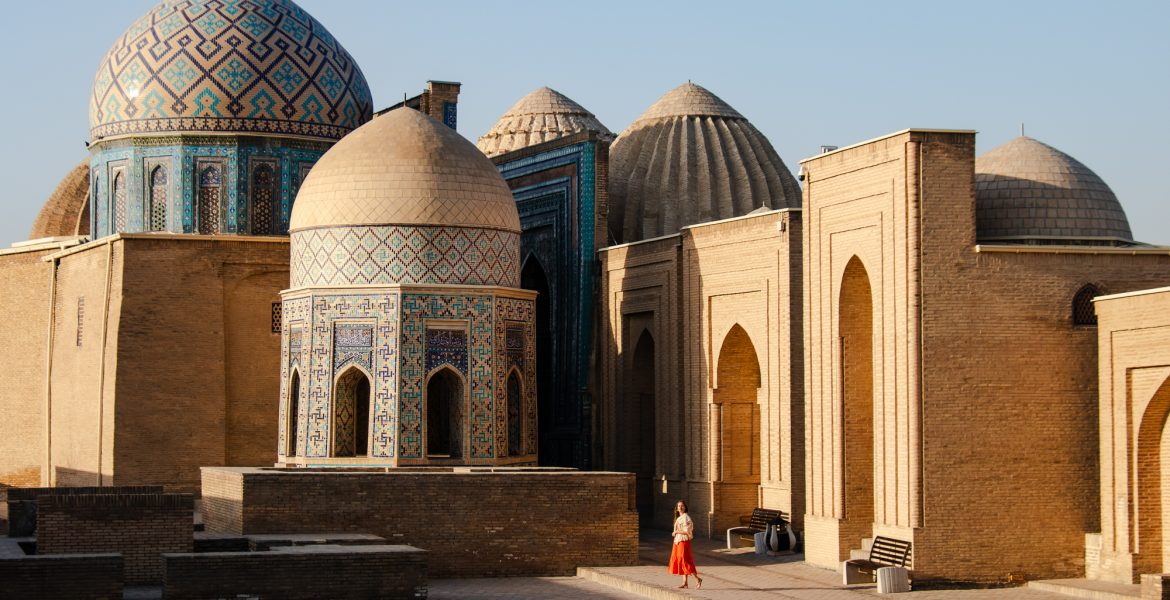
Known as the crossroads between East and West, no other city captures the starry-eyed wonder of the ancient Silk Road quite like Samarkand. As one of the oldest cities in Central Asia, its history has been shaped by countless cultures and religions. With its rich history, archaeological treasures, and stunning architecture that seems straight out of a 1001-night fairytale, Samarkand is a place you simply must see once in your lifetime.
Home to some of the world’s most intricate and exquisite architecture, Samarkand is a must-visit destination on any Uzbekistan itinerary. This city, known for its breathtaking Silk Road buildings, was once the heart of Timur’s empire and has been rising in popularity. Poets and historians have aptly described it as “The Pearl of the Eastern Muslim World.”
Get ready to marvel at the beautifully tiled architecture, indulge in the local cuisine, and spend your days in Samarkand in complete and utter amazement. In this guide, you’ll find all the top things to do in Samarkand, along with some insider tips for visiting these spectacular sights.
* Disclosure: This post contains affiliate links. We will receive a small commission if you book through our links. This is at no extra cost to you. This way you’re helping us write awesome travel guides and keep providing you with free content. We only recommend products we like and trust ourselves.

Quick Uzbekistan Trip Planning Essentials
VISA
Uzbekistan introduced FREE VISAS ON ARRIVAL or e-visa for most nationalities (30 days). Check the visa requirements on ivisa.com for your nationality before you go.
TRAVEL INSURANCE
Heymondo is our top recommendation for comprehensive and trustworthy coverage for Uzbekistan. Get 5% OFF through our link.
FLIGHTS
Discover the best flight deals to Uzbekistan on Skyscanner, and check for flights to Tashkent (the capital).
INTERNET
Airalo eSIM lets you stay connected as soon as you arrive at your destination. Use promo code NEWTOAIRALO15 for 15% off any eSIM (for new Airalo users only).
ACCOMMODATION
Top Pick ($$) Jahongir Guest House ; Budget ($) Nursultan Grand Guest House; Mid-Range ($$) ANTICA Family Guest House ; High-End ($$$) L’Argamak
TRANSPORT
The easiest way to travel around Uzbekistan is by railway. During high season it’s advisable to book your train tickets online upfront.
CURRENCY
The official currency is Uzbekistani Som (UZS). Check the Xe.com app for current exchange rates. Current exchange rate: $1 = 12,500 UZS and €1 = 13,000 UZS.
TOURS & ATTRACTIONS
This private Samarkand City Tour takes you to all the famous landmarks. For more tours and day trip excursions, check out GetYourGuide or Viator.
LANGUAGE
Basic English is spoken in major cities, but knowing basic Russian comes in handy! Recently we have been loving the Ling App to pick up some language basics.
ONLINE PRIVACY
Safeguard your online activity and digital privacy when using public Wi-Fi abroad by using ExpressVPN. Get 3 months FREE when getting a 12-month plan with our link.
Background History Samarkand
Founded in the 7th century BC, Samarkand is one of Uzbekistan’s oldest and most historic cities. It became a key trading hub on the Silk Road, where different cultures and religions came together. The Sogdians, an ancient Iranian people, settled here, trading cloth, spices, and precious metals with regions as far away as China and India. This trade made Samarkand a place where Zoroastrianism, Christianity, Buddhism, and Hinduism all took root during the medieval period. In the 8th century, the Sogdians were displaced by the Samanid Empire, which transformed Samarkand into a significant center for Islamic learning. However, this era of enlightenment was interrupted in 1220 when Genghis Khan’s forces devastated the city.
The Timurid Empire
Samarkand was rebuilt by Amir Timur in the late 14th century. Timur, a powerful military leader who also loved art and culture, made the city the capital of his empire, which stretched from Turkey and Iran to India. He encouraged a thriving cultural scene and funded grand architectural projects that defined the Timurid style. The legacy of Timur and his grandson Ulugh Beg is still visible in the city’s beautiful monuments and scholarly works. In Uzbekistan, Timur is deemed a national hero and his statues are all over the country. Definitely remember this name as you will encounter it often throughout your Uzbekistan travel!
Decline and Recovery
Samarkand’s importance declined in 1500 when Uzbek nomads took control and moved the capital to Bukhara. By the late 18th century, the city was mostly deserted. It wasn’t until the Soviet era that Samarkand was revitalized, with the construction of the Trans-Caspian Railway and extensive restoration of its Timurid monuments. These renovations were controversial: some people think they were too aggressive and damaged the authenticity of the buildings, while others believe they were necessary to save these historic structures.
Samarkand Today
Today, Samarkand is a UNESCO World Heritage site, recognized as the ‘Crossroads of Cultures.’ Visitors are amazed by its stunning architecture and rich history. The old city features Central Asian architecture from the 14th to the 20th century, including many buildings from Timur’s time. Key features of these ancient structures include their grand entrances, colorful domes, and intricate exterior decorations made from majolica, mosaic, marble, and gold.
Things to Know Before Visiting Samarkand
Is Samarkand Safe for Tourists?
Samarkand, just like the rest of Uzbekistan, is very safe, even for solo travelers. The country has a low crime rate and incredibly friendly people. You’ll quickly notice how kind the Uzbeks are! People show genuine interest, wanting to take a picture together occasionally or just to practice their English skills.
While petty crimes like pickpocketing can happen, especially in crowded places and bazaars, they are rare in Uzbekistan. Always keep your valuables in a safe place, as you would anywhere else. It’s a good idea to have travel insurance that covers both health and theft. Additionally, Uzbekistan has introduced a ‘tourist police’ in major tourist cities like Samarkand. You’ll find their booths throughout the city.
One important tip is to be cautious of overpriced taxi drivers and tourist prices. Just like in any tourist destination, never get into a taxi without agreeing on the price first. For example, a ride from Samarkand’s train station to the city center should cost no more than 20,000 UZS. When shopping at bazaars, try to bargain down the price to at least two-thirds of what is initially asked. We usually go around a bazaar and check out several stall prices to get a feel of what things might cost.
The Best Time to Visit Samarkand
The best months to visit Samarkand are April, May, and early June in spring, and then again in September and October during autumn. In spring, Samarkand is especially lovely with mild temperatures and blooming landscapes. The weather is generally pleasant, with temperatures ranging from 15°C to 25°C (59°F to 77°F). For instance, when we visited Uzbekistan at the end of September and into October, we found the weather perfect for exploring the historic cities. Therefore, we highly recommend this time of year!
Conversely, Samarkand has cold winters and very hot summers. It’s best to avoid July and August since temperatures can soar up to 40°C (104°F). If you don’t handle heat well, sightseeing can be particularly challenging during these months. However, the winter months from late November to March are quite cold and can even see snow. Nevertheless, the skies are usually clear and bright. Winter is also the quietest time of year, making it ideal if you want to avoid crowds and enjoy better prices.
How Many Days to Spend in Samarkand?
We recommend spending at least two full days exploring Samarkand with ease. Ideally, though, three days would be better if you prefer a more relaxed trip. You don’t want to rush through Registan, as the buildings contain so many intricate details that it would be a shame to hurry through them. Since Samarkand is one of the main highlights on a Uzbekistan itinerary, you’ll find that the attractions are quite large in scale and located quite spread out from each other. Consequently, you will need ample time to fully explore them. For example, visiting Registan can easily take up more than half a day if you enjoy architectural details. Therefore, taking your time will allow you to appreciate the city’s rich history and stunning architecture.
How to Get Around Samarkand?
Samarkand is much larger than Khiva and Bukhara, and unlike those two, it doesn’t have a single old town with all the attractions close together. Instead, the major attractions are spread out. However, it’s still walkable, with 15-30 minutes between each site. The only time we took a Yandex taxi was to the Ulugh Beg Observatory.
If you need a taxi, be sure to download the Yandex App. This ride-hailing app shows prices for rides upfront, making it easy to use and avoiding the hassle of bargaining with drivers. If you do decide to grab a taxi, always agree on a price before getting in. For example, the typical rate is around 12,500 som ($1 USD) for a 10-15 minute ride. To get from the Samarkand train station to the city center (Registan), it usually costs a maximum of 20,000 UZS.
For those with limited time, guided city tours are a great way to dive into the local culture and history while ensuring you don’t miss any key sights. We highly recommend the following private Samarkand City Tours, which cover all the major landmarks.
Packing Essentials for Samarkand
- Lightweight Cotton Scarves: Essential for covering up in mosques or religious sites. Keep one handy in your bag to be prepared.
- Loose Dresses and Long Skirts: Opt for breathable, flowy outfits to stay cool in the heat while dressing modestly.
- Reliable Daypack: A good daypack is crucial for daily outings. Look for a lightweight option from brands like Deuter or WANDRD if you’re bringing camera gear.
- Comfortable Walking Shoes: Go for lightweight everyday shoes or sandals like Birkenstocks. You will be doing a lot of walking in Samarkand, so you’ll want comfortable footwear for exploring. ( his / hers )
- Reusable Water Bottle: Staying hydrated is key. For safer drinking water, consider a GRAYL bottle.
- Action Camera: Capture all your adventures! We’ve found the GoPro Hero 10 to be a reliable choice for videos on the go.
- Camera for Photography Enthusiasts: Samarkand is absolutely photogenic, so you will want to pack your camera for sure! An entry-level DSLR like the Canon EOS Rebel T7/2000D or a mirrorless camera like the Sony Alpha A6100 or Sony α6400 is worth considering.
- Universal Adapter: Since Uzbekistan has different plug types, a universal adapter is a must to keep your devices charged.
- Power Bank: A power bank is a lifesaver for long travel days when power outlets may not be available, especially during train rides or extensive sightseeing.
Where to Stay in Samarkand?
You’ll find plenty of beautiful, high-rated, and affordable accommodation options in Samarkand. We recommend staying close to the Registan for easy access to the historic sites. If you have your eyes set on a specific guesthouse or hotel, it’s best to book in advance, as popular places get booked quickly during the high season. We hand-selected the options below based on their proximity to sights, high ratings, comfort, and typical Uzbek courtyard style. If you prefer a modern hotel with a swimming pool, most of those are located further away.
TOP PICK | Jahongir Guest House
This family-run guesthouse is a favorite in Samarkand. The rooms feature beautiful Uzbek textiles, and the lush courtyard is perfect for relaxing. It’s a short walk to the city, with a delicious traditional Uzbek breakfast each morning.
HIGH-END HOTEL | L’Argamak
This hotel combines luxury with Uzbek charm. The blooming rose garden and benches offer a peaceful retreat close to major monuments. Enjoy breakfast on the terrace with continental and local dishes.
MID-RANGE BED & BREAKFAST | ANTICA Family Guest House
This Bed & Breakfast has a charming garden and daily fresh breakfast. Traditional Uzbek dinners are available on request. Centrally located, it’s run by a friendly, helpful family.
BEST VIEWS | Bibikhanum Hotel
Right in Samarkand’s heart, this hotel offers rooms with balconies overlooking the Bibi-Khanym Mosque. It’s a short stroll to the bazaar and Registan. Despite its central location, it maintains a peaceful atmosphere.
BUDGET | Nursultan Grand Guest House
This place is perfect for budget-conscious couples. Located on a quiet street near the main sights, it offers spacious, modern rooms. Enjoy a beautiful courtyard and a hearty breakfast daily.
HOSTEL | Amir Hostel
Amir Hostel is ideal for solo travelers or friends on a budget. Dorm rooms have lockers, curtains, lights, and power sockets. It’s slightly further from the center but highly rated for its helpful staff, homely vibe, and plentiful breakfast.
Best Things to Do in Samarkand
From all the places in Uzbekistan, Samarkand is probably the biggest hotspot for tourists. Although Uzbekistan isn’t on every traveler’s radar yet, it is gaining popularity. Organized tour groups are flocking to this UNESCO World Heritage site. Visitors come from all over the world to marvel at its stunning architecture, vast history, and archaeological treasures.
As it’s one of the biggest highlights of any journey along the Silk Road, expect crowds and busloads of organized tour groups. We were lucky during our visit in early autumn and only encountered a few tourist groups. These groups usually arrive after 9 am, so we suggest starting your days bright and early to have places more to yourself.
SAMARKAND HIGHLIGHTS
Get stunned by the beautiful architecture of Shah i Zinda for sunrise
Stare at the magnificent gold & blue ceiling inside the Mosque of the Tilya-Kori Madrasah
Enjoy tea with a view inside the Registan
Attend the evening light & culture show performance at the Registan
Interact with the locals & taste delicious sweet Halva at the Siyob Bazaar
The main attraction in Samarkand is undoubtedly Registan Square. It’s the most iconic sight in Uzbekistan. A picture of Registan inspired us to dream of traveling to Uzbekistan. Another stunning historical site, and our personal favorite in Samarkand, is the Shahi-Zinda Complex.
We initially expected Samarkand to have a scenic old town, but that’s not the case. Unlike Bukhara, Samarkand is known for its major landmarks, which are spread out across town. The sights have been heavily restored, similar to Khiva, so it has less of the raw, untouched feeling that Bukhara has. Samarkand is truly magnificent, but it’s important to have the right expectations.
With rising tourism comes an increase in tourism supply. Hawkers and souvenir stands are popping up on every corner, crowding the historic sights. Despite this, the best things to do in Samarkand are truly unforgettable and worth every moment spent exploring this incredible city.
1. Marvel at the Magnificent Registan
One of the most spectacular things to do in Samarkand is visiting Registan, its crown jewel. Our first ‘wow’ moment in Samarkand was when we arrived at Registan Square on our first evening for sunset. It’s hard to describe the magnificence of this historic place, with its three impressive madrasahs (Arabic word for school) surrounding the square. Each madrasah has its own unique entrance with beautiful colorful tilework and two grand portals.
The turquoise domes, colorful mosaics, and towering minarets present so many intricate details to witness that it felt overwhelming! No wonder we spent more than half a day exploring this place. The Registan is truly the crown jewel of Samarkand, exuding a 1001-night fairytale ambiance.
During the Timurid Empire, this public square was used for royal announcements and public executions. It was regarded as the heart of the Timurid Renaissance. There were trading rows around the square where artists and farmers sold their items. In those days, all the roads leading into Samarkand would converge at the Registan, making it a lively gathering place.
Today, it’s just as busy, but with tourists. We recommend heading there early or later in the day for better lighting for photos and fewer tourists. The square is framed by three madrasahs (Islamic schools). From the viewing platform, Ulugh Beg Madrasah will be on your left, Tilya-Kori Madrasah in the center, and Sher-Dor Madrasah on your right. Each madrasah housed two stories of classrooms and residential dorms for students and professors. You can go inside each one and explore their majestic courtyards.
Opening Time | Daily from 8 am – 7 pm (April – September) 9 am – 5 pm (October – March)
Entrance Fee | 50,000 Som per person – Ticket is only valid once
Visit the Mosque inside Tilya-Kori Madrasa
As you walk into Registan Square, Tilya-Kori Madrasah is the one in the center and arguably the most impressive. We advise visiting this one first! Step inside to see a peaceful courtyard surrounded by trees and benches. Here, you’ll also find the entrance to the Tilya-Kori Mosque.
Tilya-Kori means covered in gold, and it is known as the largest and most glorious structure in Registan Square. This name refers to the lavish gold gilded decoration of its mosque’s domed chamber. You will notice all the gold as soon as you walk in – the decorations are grand.
FUN FACT | About its ceiling, it’s a magnificent illusion: it looks like a dome, but it’s actually completely flat.
Enjoy tea with a view inside Ulugh Beg Madrasah
When you stand in front of the Registan, Ulugh Beg Madrasah is the one on your left. Named after Amir Timur’s grandson, Ulugh Beg was a prominent astronomer of his time and a strong advocate for education, science, and art. This madrasah was considered one of the best religious colleges in the Muslim world in the 15th century, nurturing many notable Persian poets and philosophers.
The madrasah has four walls surrounding a central courtyard. Within these walls are a mosque, lecture rooms, and dormitory cells where students once lived. Today, the ground level features souvenir shops around the courtyard.
TIP | If you walk to the shop at the far end of the courtyard on the right, you will find a small hidden door. This door opens to a staircase leading up to the second floor of the building. The view from the top is spectacular, offering a unique perspective of the courtyard and the madrasah’s walls. The best part is a little café with a super friendly owner. Here, you can enjoy tea with an amazing view, perfect for soaking up the atmosphere and all the beautiful surroundings.
Go souvenir shopping inside Sher Dor Madrasah
That brings us to the third and final Madrasah on the right-hand side of Registan Square. Before heading inside, take a minute to admire the façade adorned with various animals and Zoroastrian suns. It’s truly spectacular and unique! The name translates to “Madrassah of the Lions,” named after this mosaic motif on the entrance portal, known as ‘Tiglon.’
In our opinion, the facade is the most impressive feature of this 17th-century madrasah. Parts of the interior are still being renovated, but you can still admire some of the finest tilework inside. Besides some shops with beautiful souvenirs, you can also find tapchans (typical outdoor furniture from Central Asia) in the courtyard to take a break and enjoy the scenery. The souvenir shops here sell everything from suzanis (traditional hand-embroidered textiles), tubeteika (traditional Central Asian headwear), pichok (Uzbek knives), to beautiful magnets. Uzbekistan has some of the most unique-looking magnets we’ve ever seen, and you definitely want to score one if you’re a magnet collector like us. You won’t find these tile-inspired magnets in other cities.
In the past, the courtyards of Registan’s madrasahs were surrounded by residential rooms for students and professors, typically on the first floor. These days, the madrasahs inside Registan aren’t used for education anymore. Instead, many locals have small spaces here where they sell handmade products or souvenirs. Interestingly, parts of the former residential rooms can still be seen inside some of these souvenir stores, and some vendors are happy to show them to you.
TIP | Make sure to haggle whenever shopping at shops or bazaars. Try to bargain down the price to at least two-thirds of what is initially asked.
2. See a traditional performance inside the Registan
One of the fun things to do in Samarkand is attend a traditional dance and music performance inside the Sher-Dor Madrasah. If you’re at the Registan at 7 pm during the high season, you can catch this captivating show. You can buy tickets at the entrance of the Registan for 60,000 UZS, the same place where you purchase entrance tickets for Registan.
Music plays a significant role in Uzbek culture, influenced by notable poets and ancient folklore. Against the backdrop of beautifully lit madrasah tiles, performers in traditional costumes play Shashmaqam instruments, a music genre unique to Uzbekistan and Tajikistan. The musicians and dancers showcase not only their music but also their culture. They act out scenes from a traditional Uzbek wedding, immersing you in the local traditions. Towards the end of the show, the dancers even invite audience members to join them on stage and dance along!
Show Time | Starts at 7 pm daily and lasts for 1 hour
Entrance Fee | 60,000 som (~$5)
3. Climb to the top of a 400-year-old minaret
One of the more unique things to do in Samarkand is climbing the 40-meter tall minaret of the Sher-Dor Madrasah for a stunning view over the Registan. This activity was once a well-kept secret, as it wasn’t officially advertised. In the past, you had to approach a guard around sunset, when the Registan was less busy, to take you up the minaret for a fee. Nowadays, it’s much easier to arrange. During our visit, guards were actively approaching foreign visitors, asking if they wanted to go up for $10 per person.
The guard will lead you halfway up the staircase. From there, it’s a steep, narrow, and dark climb to the top, navigating through spider webs and dust. Be aware that this climb isn’t easy. This part of the minaret is not well-maintained, making the ascent tricky. Honestly, we decided not to do it ourselves after seeing pictures and hearing about the experience from others. It didn’t quite persuade us. If you’re claustrophobic or afraid of heights, this might not be the best activity for you. At the end of the staircase, there’s a small platform that fits only one person at a time, allowing you to pop your head through the top part of the minaret.
4. Catch the light & culture show at the Registan in the evening
If you thought the Registan was magical by day, wait until the sun sets! One of the most enchanting things to do in Samarkand is witnessing the Registan at sunset. We experienced some of the most magical sunsets right at the Registan, where the tiles of the madrasahs light up in beautiful orange hues. We visited the Registan twice, once in the morning and once before sunset, and we actually preferred the sunset visit. As the sun sets, the lights of the Registan are turned on, making the architecture pop even more as the buildings are stunningly illuminated.
But there’s more! In recent years, they have started organizing a spectacular light and culture show at the Registan during high season. This show is projected daily, twice in the evening, once at 8 pm and again at 9 pm. You might think, “A light show, cool, and then?” But you definitely don’t want to miss this one! It was one of our highlights in Samarkand and truly spectacular. The 40-minute-long show projects the history of humankind and Uzbekistan, effectively taking you on a journey through time. The renovated square in front of the Registan now has steps and a viewing platform. People start gathering well in advance, so make sure to get a good spot to view the show. Vendors even come around with popcorn, adding to the festive atmosphere.
Show Times | Daily during high season (from May until the end of September) at 8 pm & 9 pm for around 40 minutes.
Entrance Fee | Free!
5. Visit the opulent mausoleum of Gur-e-amir
Not far from the Registan, you’ll find the Gur-e-Amir, the final resting place of Amir Timur, founder of the Timurid Empire, and his grandson Ulugh Beg. Visiting this site is one of the essential things to do in Samarkand. Gur-e-Amir, meaning “Tomb of the King” in Persian, is a stunning architectural complex with a ribbed turquoise dome. You’ll encounter Amir Timur’s name frequently throughout your journey in Uzbekistan, especially in Samarkand, as he is the country’s national hero. Interestingly, Timur originally wanted to be buried in Shahrisabz, his birthplace, where he had a crypt built for himself. However, due to heavy snow blocking the road, his body was brought to Samarkand instead. Gur-e-Amir then became the family tomb, with his sons and grandson also buried there.
Dress Code | Since this is a sacred site, remember to cover your knees and shoulders, especially before entering the mausoleum.
The entrance is marked by a stunning gate decorated with blue mosaic and intricate patterns. As you step inside, the interior of the mausoleum will take your breath away. The walls and ceiling are adorned with gold leaf and elegant turquoise arabesques. The splendid Gur-e-Amir mausoleum is one of the most astonishing things to see in Samarkand. No wonder it is part of the 2001 designation of Samarkand as a UNESCO World Heritage site. Its intricate tilework is mesmerizing and has inspired many architects. Interestingly, the architecture of Gur-e-Amir even inspired the Taj Mahal in India!
TIP | Visit Gur-e-Amir early in the morning at opening times or wait until the tourist groups have left. The tomb isn’t huge, and one tourist group can easily fill up the place, making it noisy and hard to appreciate its beauty.
Opening Time | Daily from 9 am – 7 pm
Entrance Fee | 30.000 SOM
6. Marvel at the stunning Shah-i-Zinda mausoleum
The Registan may be the iconic postcard of Samarkand, but our favorite sight was the necropolis Shah-i-Zinda. Shah-i-Zinda is hands down one of the most magnificent places to visit in Samarkand. This sacred necropolis houses the remains of both famous and unknown people and showcases some of the richest tilework in the Muslim world, many dating back to the 14th-century Timurid Empire.
The name “Shah-i-Zinda,” which means “Tomb of the Living King,” refers to its original and holiest shrine. This complex likely contains the grave of Qusam ibn-Abbas, who is said to have brought Islam to this area in the 7th century. Between the 11th and 19th centuries, various mausoleums and temples were continually added, forming the avenue of magnificent mausoleums that stand today. The rich tilework and mosaics in each mausoleum make it one of the top Samarkand points of interest. The city undertook a massive restoration project in 2005, which created a lot of controversy. While the beautiful mosaics, majolica, and terracotta work you see today are not original, the restoration has been done magnificently, recreating the historical beauty of the site.
We visited at sunrise, and the morning sun lighting up the turquoise tiles and sandstone buildings was magical. This place gets very busy during the day with locals paying their respects and huge tourist groups. To have this spectacular place mostly to yourself, it’s best to visit at sunrise or sunset. At these times, you’ll mostly encounter photography enthusiasts, making it a great time to appreciate the beauty and share your love for architectural photography with like-minded travelers.
TIP | As this is a sacred place, make sure to dress modestly and do not speak loudly.
Opening Time | Daily 7 am – 7 pm
Entrance Fee | 40.000 SOM
7. Gaze up the gigantic Bibi Khanum mosque
Another impressive Samarkand attraction is the Bibi-Khanym Mosque, one of the largest mosques in the Islamic world. Completed in 1404, it was the jewel of the Timurid Empire, capable of holding up to 10,000 worshippers. It was built under Timur’s rule, who loved creating grand buildings. Though Timur had many wives, his favorite was Bibi Khanum, and that’s why this spectacular mosque bears her name. It’s said that architects from Iran and India worked on the project, using ninety-five elephants to haul construction material.
However, legend has it that it was actually Timur’s wife who ordered this mosque as a gift for him before his return from India. The architect fell in love with her, causing construction to progress slowly. When she pushed him to finish faster, he demanded a kiss on his cheek. After some hesitation, she agreed, and the mosque was beautifully completed just in time for Timur’s return. Unfortunately, Timur discovered the architect’s affection and ordered him to be killed and buried beneath a mausoleum.
The mosque was reduced to ruins by the 1897 earthquake, with reconstruction beginning in the 1970s under Soviet rule. After the fall of the USSR, Uzbekistan’s first president, Islam Karimov, put significant effort into restoring Timurid-era monuments, and much of the mosque was quickly rebuilt.
Opening Time | 8 am to 8 pm daily
Entrance fee | 30.000 SOM
8. Enjoy lunch with a view at Bibi Khanum Hotel
Want to enjoy a meal while overlooking one of Samarkand’s most significant monuments? Treat yourself to traditional Uzbek dishes like plov or manti on the terrace of the Bibikhanum Hotel, just a stone’s throw from the mosque. Dining here is undoubtedly one of the coolest things to do in Samarkand.
If you’re still deciding where to stay in Samarkand, the Bibikhanum Hotel is an excellent choice! Located centrally among all the main attractions, the Siyob Bazaar and Bibi Khanum mosque are just next door, and Shah-i Zinda and Registan are just a 15-minute walk away.
Get Connected with an eSIM
Secure reliable internet access for your Uzbekistan trip with Airalo. Airalo eSIM lets you stay connected as soon as you arrive at your destination. Simply install it on your eSIM-compatible smartphone before your journey. It’s easy, convenient, and affordable + you don’t have to keep switching SIM cards! Use our promo code NEWTOAIRALO15 for 15% off any eSIM (for new Airalo users only). Use AIRALOESIM10 for 10% off as an existing user.
9. Experience local shopping at Siyob Bazaar
Next to the Bibi Khanum Mosque, you’ll stumble upon the lively Siyob Bazaar. Upon entering, prepare to be greeted by a delightful array of smells and colorful fruits and vegetables. It’s a bustling place where you can soak in local life, chat with the friendly vendors, and get a real taste of daily activities. This market truly has it all. From fresh Uzbek bread and aromatic spices to a variety of nuts and dried fruits. There are also pharmacies and souvenir shops nearby.
Exploring the bazaar was a highlight for us. We loved sampling the local delicacies, especially the sweet delicious halva, which we found near the entrance on the left. It’s perfect with a cup of tea and comes in flavors like pistachio, white or dark chocolate, and more. Remember to negotiate; paying around 5,000 UZS for a bar of halva is reasonable.
Apart from the delicious treats, Siyob Bazaar is ideal for souvenir shopping. While the Registan offers unique magnets, here you can find exquisite silk textiles like kaftans, also known as chapan, with traditional ikat patterns. We also picked up a couple of tubeteikas, the traditional Central Asian caps.
TIP | Bargaining is part of the shopping experience in Uzbekistan. Try to bring down the initial price to about 75% of what’s asked.
Opening Hours | Tuesdays – Sundays from 5 am until 7 pm, closed on Mondays
10. Indulge in the local Uzbek cuisine
Uzbekistan’s culinary heritage shares similarities with Turkish cuisine, and its noodle and dumpling dishes are reminiscent of those found in China, Nepal, and other Eastern Asian countries.
The food in Uzbekistan is hearty and meat-centric, so expect to indulge during your trip – you might even gain a couple of kilos! To balance out the richness, be sure to try some of their refreshing fresh salads, which are generously seasoned and make perfect side dishes.
Here are some traditional Uzbek dishes you shouldn’t miss:
- Plov: Considered the national dish, it’s made with long-grain rice, yellow carrots, onions, and mutton, sometimes enriched with chickpeas and raisins depending on the region.
- Uzbek bread (non): Round and flatbread baked in a tandyr (clay oven).
- Shurpa: A hearty lamb and vegetable soup.
- Shashlik: Skewered meat grilled to perfection, often allowing you to choose your preferred protein at certain grill restaurants.
- Laghman: Typically served as a hearty soup with noodles and lamb stewed with onions, carrots, bell peppers, tomatoes, potatoes, and garlic.
- Fried Laghman: Noodles stir-fried with peppers, onions, tomato paste, and assorted vegetables.
- Manti: Dumplings filled with either meat or pumpkin, a popular Uzbek dish.
- Samsa: Flaky pastries with various fillings, the most popular being pumpkin and seasoned with Uzbek spices.
- Chuchvara: Small dumplings filled with meat and served with smetana (sour cream), can be compared with Russian pelmeni or Italian tortellini.
TIP | While Uzbek cuisine is meat-focused, many restaurants offer vegetarian options. If you’re vegetarian, simply say “bez myasa” when ordering salads to ensure they are served without meat.
11. Pay a visit to the President’s Tomb
The President’s Tomb in Samarkand is a memorial place to Uzbekistan’s first president, Islam Karimov. This impressive mausoleum was constructed over his resting place, blending modern and medieval architectural techniques seamlessly.
Central to the mausoleum is the tombstone, crafted from white onyx and adorned with verses from the Quran and Timurid era inscriptions. The walls are embellished with intricate gold leaf designs, and the portals are adorned with quotes by President Karimov in Uzbek, English, and Arabic.
Remember to dress modestly by covering your knees and shoulders as a sign of respect. While strolling around the tomb is free, entry to the interior requires a fee of 15,000 som per person. Positioned strategically, it offers a panoramic view overlooking the city of Samarkand.
NOTE | You are not allowed to use your camera inside!
Opening Time | 8 am – 6 pm daily
Entrance fee | 15,000 som
12. Stroll along the University Boulevard
University Boulevard serves as Samarkand’s hub for education and science, hosting several universities, schools, and institutes nearby. Many hotels and hostels are also situated along University Boulevard Street. If yours happens to be there too, a pleasant way to begin your day is by strolling down this street toward Gur-e-Amir, one of Samarkand’s prominent attractions. The boulevard spans 128 meters and is adorned with striking buildings and trees, creating a refreshing green space in the heart of the city.
At the end of University Boulevard Street, you’ll find a statue of Amir Timur seated on his throne. It marks the junction between the historic Uzbek quarter and the modern Russian-designed district of Samarkand.
If you have more time in Samarkand, Uzbekistan
The activities below aren’t really a must-visit in our opinion and can be easily skipped if you are short on time. These Samarkand activities also depend hugely on personal interest, whether you are a wine lover, interested in astronomy, or a huge history buff.
Learn about astronomy at the Observatory of Ulugbek
Built in the 1420s by Ulugh Beg, the Timurid astronomer and grandson of Amir Timur, the Ulugh Beg Observatory was once celebrated as one of the premier observatories in the Islamic world.
Ulugh Beg’s prowess as an astronomer overshadowed his reputation as a ruler. The observatory exemplifies his pioneering work in advanced astronomical studies. During Ulugh Beg’s rule, Samarkand flourished as a center of scientific inquiry.
Tragically, the observatory met its demise in 1449 at the hands of religious extremists after Ulugh Beg’s execution. Rediscovered in 1908 by a Russian archaeologist, the observatory’s historical significance was reaffirmed. It pioneered the prediction of eclipses, determination of solar positions, measurement of the year’s duration, and documentation of over 1,018 stars—all centuries before the advent of the telescope.
Today, the Ulugh Beg Observatory is a small museum showcasing a replica of the ancient observatory, a copy of a 1605 world map created there, and an engraving depicting Ulugh Beg alongside Tycho Brahe and Ptolemy, European astronomy pioneers. The sole surviving artifact, the sextant used for determining midday, remains under a protective roof, offering visitors a glimpse into its remarkable past through the large viewing hole.
Opening hours | Open daily from 9 am – 7 pm
Entrance Fee | 30,000 per person
Do a wine tasting at Khovrenko Winery
Did you know that Uzbekistan is the primary wine producer in Central Asia? The country boasts a variety of exceptional wines, including dry, semi-sweet, sweet, red, and white varieties. For a delightful experience, consider joining the Samarkand Wine Tasting Tour. This two-hour excursion unfolds at the Khovrenko Winery and the Samarkand Museum of Winemaking, where a knowledgeable guide will unveil the secrets of Uzbek wine and more.
The ancient Afrasiyab settlement
One of the unique things to do in Samarkand is visiting the ancient site of Afrasiyab. This area, the oldest part of Samarkand, is one of the largest archaeological sites in the world. Before Samarkand’s Silk Road period, it was a major settlement. From around 500 BC to 1220 AD, Afrasiyab was ruled by the Sogdians, an Iranian civilization known for mastering the Silk Road trade and practicing Zoroastrianism.
Afrasiyab today is a hilly mound near the Bibi-Khanym Mosque. While most of the city remains buried, ongoing excavations reveal houses, tombs, and artifacts. Discovered in 1894, over 20,000 artifacts including swords, pottery, and jewelry are displayed in the nearby Afrasiyab Museum.
The site offers beautiful views, but wear sturdy shoes as the ground is uneven with hidden holes. A guide can enhance your visit by explaining the excavated structures. The Afrasiyab Museum next door provides deeper insights into the history, culture, and traditions of the area’s ancient inhabitants, showcasing unique artifacts like jewelry, swords, and frescoes.
Opening Hours | 9 am – 8 pm, the museum until 6 pm
Entrance fee | 22,000 som
Maps of all the Best Things to Do in Samarkand
To help you navigate all the amazing things to do in Samarkand, we’ve created an interactive map highlighting all the mentioned sights and locations. You can access the map through this Google Maps link, which is free to open, save, and use as a handy guide for your upcoming trip to Uzbekistan.
Practical Travel Resources
TRANSPORTATION | The easiest way to travel around Uzbekistan is by railway. For hassle-free bookings, we recommend using the user-friendly platform 12go.Asia. Skip the queues and reserve your tickets in advance, especially during peak seasons.
ACCOMMODATION | Booking affordable accommodations in Uzbekistan is effortless with Booking.com. This platform is perfect for discovering budget-friendly hostels, guesthouses, and hotels tailored to your preferences.
FLIGHTS | Discover the best flight deals to Uzbekistan on Skyscanner. Benefit from their feature highlighting the cheapest days to fly and check for flights to different cities.
TRAVEL INSURANCE | Ensure comprehensive and reliable coverage for your backpacking journey in Uzbekistan with Heymondo. Prioritize peace of mind with their trustworthy travel insurance options. Get 5% OFF through our link.
STAY CONNECTED | Guarantee reliable internet access throughout your Uzbekistan trip by using Airalo. Install it on your eSIM-compatible smartphone before your journey for convenient connectivity. Use promo code NEWTOAIRALO15 for 15% off any eSIM (for new Airalo users only).
TOURS & ATTRACTIONS | Explore the best city tours, day excursions, and cooking classes in Uzbekistan with GetYourGuide or Viator.
VISA ORGANIZATION | Uzbekistan introduced FREE VISAS ON ARRIVAL or e-visa for most nationalities (30 days). Make sure to check the visa requirements on ivisa.com for your nationality before you go.
ONLINE PRIVACY | Always safeguard your online activity and digital privacy when using public Wi-Fi abroad by using a VPN. We’ve trusted ExpressVPN for years! Plus, a VPN lets you stream Netflix shows from any country. Get 3 months FREE now when getting a 12-month plan with our link.
No time to read now? Pin it to Pinterest for later!



If you could do Uzbekistan all over again, what would be your path and how many nights/days in each?
Love that question! And in all honesty we would do it exactly the same all over again, the trip was pure magic and a great combination of culture, nature & history. We started in Tashkent (definitly don’t skip it, the capital is really nice), the famous Silk Road Cities (Samarkand, Bukhara & Khiva), but also included time in the Nurota Mountains where we hiked between rural villages, spend the night in a yurt in the Kyzylkum Desert. After Khiva we visited the Khorezm fortresses on our way to Nukus from where we did a two day trip to the Aral Sea which was also unforgettable. For all this I would say you need 3 weeks for Uzbekistan. You can definitly check out our ready to copy Uzbekistan itinerary post if you think of visiting yourself: https://rootsabroadtravel.com/uzbekistan-itinerary/ , we give different itineraries depending on the time you would like to visit 😉